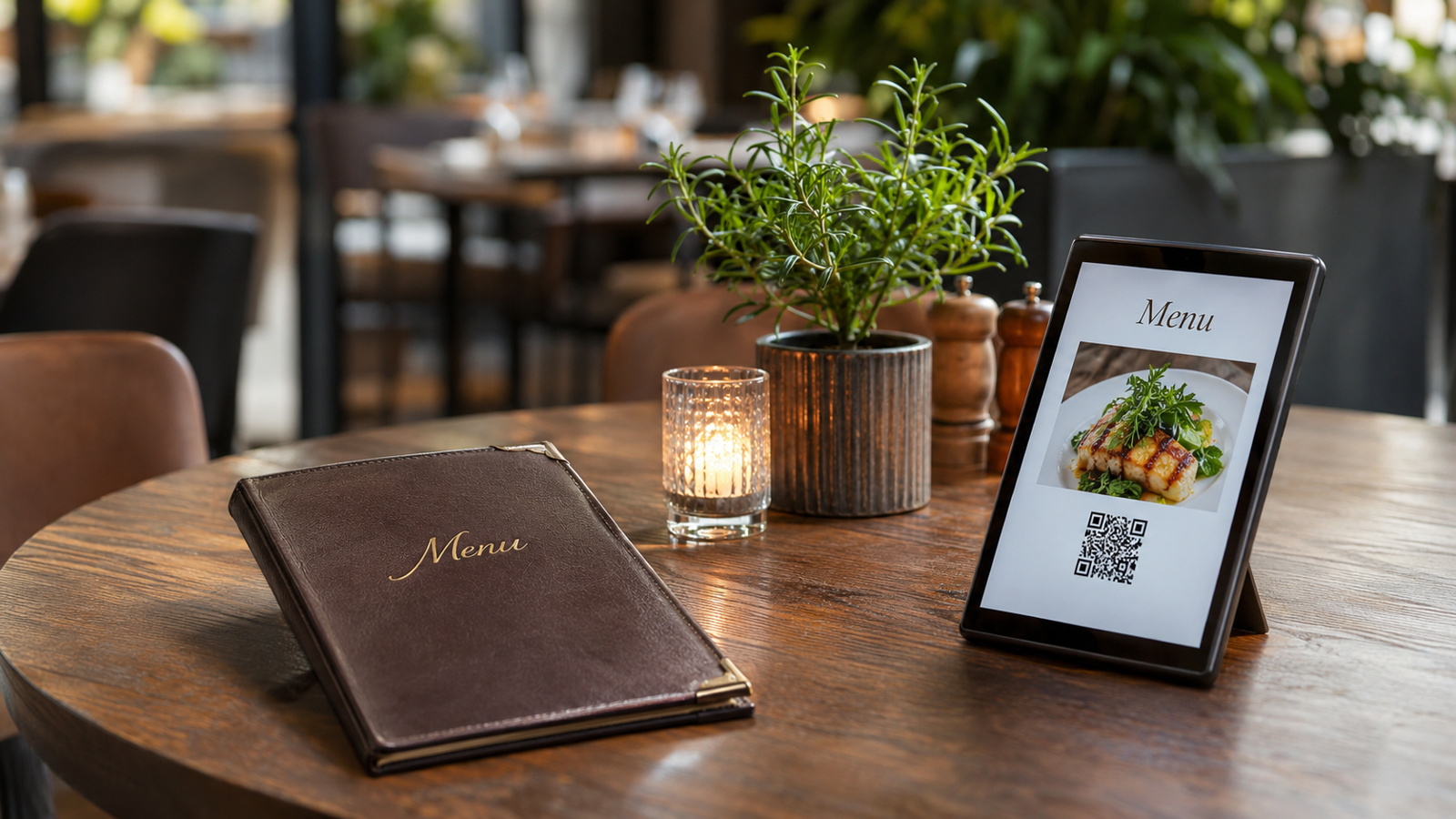
Printed menus or QR codes? The right choice depends on the restaurant and its guests. AI-generated illustration.
Digital ordering systems, QR code menus, and automated payments promise greater efficiency and lower operating costs. But what happens when technology changes the experience customers are paying for? For restaurant operators, the consequences can extend far beyond faster service, affecting average spending, customer loyalty, and ultimately profitability.
Imagine stopping at a supermarket to buy a bottle of water. Instead of joining a checkout line behind several customers with full shopping carts, you use the self-checkout, scan your bottle, pay, and leave. It takes less than a minute, and the convenience is undeniable. Return to the same supermarket with a cart full of groceries, however, and the experience may be quite different. You have to scan every item, weigh the produce, deal with an unexpected error, and wait for an employee to approve a purchase. What seemed like a clever time-saving solution has suddenly become an additional chore.
Restaurants are facing a similar dilemma as digital menus, ordering applications, self-service kiosks, and automated payment systems become increasingly common. These technologies can simplify operations and relieve pressure on employees, particularly during busy service periods. Yet a process that saves time for the restaurant does not necessarily make dining more enjoyable for its customers. Some guests welcome the independence of ordering and paying on their phones, while others wonder why they are being asked to perform tasks that were previously included in the service.
The distinction matters because restaurant technology is ultimately a business investment. Its success should be measured not only by how efficiently a system operates, but also by what it contributes to the customer experience and the restaurant’s financial performance.
How Restaurant Technology Affects the Customer Experience
Consider a restaurant in a busy downtown business district, where many customers have limited time for lunch. They want to order quickly, receive their meals without unnecessary delays, and return to work. A digital ordering system or the ability to settle the bill directly at the table could make a noticeable difference to their experience. The same approach might be less welcome at a family-owned restaurant where regular customers have been coming for years, know the owners, and enjoy discussing the daily specials with familiar employees.
Even within a single establishment, expectations can vary considerably. A couple celebrating an anniversary may appreciate attentive service and an unhurried evening, while those same guests might prefer a faster, more independent experience during a short lunch break. Age is not necessarily a reliable indicator either. Someone in their sixties may be perfectly comfortable making reservations online but still enjoy browsing a printed menu, while a younger guest who routinely uses mobile payments may consider personal table service an essential part of dining out.
These differences make it difficult to identify a universally ideal level of automation. The appropriate approach depends on the restaurant’s concept, its clientele, and the occasions that bring people through the door.
Understanding Customer Preferences Before Investing in Restaurant Technology
Restaurant owners often know more about their customers than they realize. Reservation records reveal whether a business primarily attracts couples, families, larger groups, or business diners, while point-of-sale data can show how average spending differs between lunch and dinner. Employees contribute another perspective. They notice when guests become impatient, recognize those who enjoy recommendations, and hear complaints that never appear in online reviews.
Taken together, this information can reveal where technology might deliver genuine improvements. A restaurant near an office complex, for instance, may discover that weekday lunch customers are particularly sensitive to waiting times. Faster payment options could solve that problem without changing the way orders are taken. In a tourist destination, multilingual digital menus with clear ingredient and allergen information might help international visitors navigate unfamiliar dishes while allowing employees to focus on hospitality.
A neighborhood restaurant with a loyal local clientele could reach a different conclusion. If guests are generally happy with the service but frequently complain about waiting for the check, replacing the entire ordering process would be an unnecessarily expensive response. A simpler payment solution might address the frustration while preserving the atmosphere customers already appreciate.
The commercial advantage comes from identifying a specific problem before committing money to a solution. Otherwise, restaurants risk investing in features that look impressive during a software demonstration but make little difference during everyday service.
Digital Ordering Systems: Efficiency Versus Guest Convenience
Technology providers understandably emphasize faster service, improved order accuracy, reduced labor requirements, and smoother payment processes. These promises are particularly attractive in an industry facing rising operating costs and persistent staffing challenges. Allowing guests to place their own orders can reduce repetitive tasks for employees, potentially giving them more time to handle other responsibilities.
The customer’s experience, however, depends on how the system works in practice. Digital ordering may require guests to navigate an unfamiliar interface, search through several menu categories, enter special requests, and resolve problems without immediate assistance. At a quick-service restaurant, the ability to customize a meal on a touchscreen can be useful, particularly when the alternative is waiting in line. At a full-service establishment, being required to complete the same steps may feel like a reduction in hospitality.
QR code menus illustrate the distinction particularly well. They allow restaurants to update prices without reprinting menus, provide translations, and display detailed information about ingredients. For guests who prefer digital access, these features can be genuinely helpful. Problems arise when scanning a code becomes the only available option, regardless of whether customers find it comfortable or practical.
The impact can extend beyond immediate satisfaction. If a guest finds the ordering process frustrating, that frustration becomes part of the overall dining experience, even when the food itself is excellent. Restaurants therefore need to consider whether the operational benefits of a particular system outweigh any friction it introduces into the visit.
Can Digital Ordering Systems Increase Restaurant Sales?
One of the more attractive arguments for digital ordering is its potential to increase average order value. A customer selecting a burger on a touchscreen might automatically receive suggestions for fries, a larger drink, or dessert. These offers can appear consistently, regardless of how busy the restaurant is or whether employees remember to recommend additional items.
For high-volume operations, this consistency can be valuable. Operators can experiment with different combinations, monitor which suggestions generate additional purchases, and adjust the offers accordingly. Yet automated recommendations are not the only way to encourage guests to spend more, and they are not necessarily the most effective approach in every setting.
An experienced server can recommend a wine that complements a particular dish, describe a special in an appealing way, or recognize when a table might enjoy sharing a dessert. Such recommendations can feel natural because they respond to the conversation and the occasion. Digital prompts, by contrast, may become irritating if customers encounter too many offers or feel pressured to add items they had no intention of ordering.
The presentation of the menu itself also deserves attention, as one real customer experience illustrates.
QR Code Menus vs. Printed Menus: A Real Customer Experience
For years, two regular customers visited a popular restaurant that served lunch exclusively. The dining room was consistently busy, and service was remarkably fast, sometimes almost too fast. One of the restaurant’s most memorable features was an oversized printed menu filled with beautifully photographed dishes, each presented against an attractive background. Browsing through its pages was part of the pleasure of visiting. The photographs made the food so appealing that the customers frequently ordered an appetizer, a main course, and dessert.
Then, on a subsequent visit, the printed menus were gone. They had been replaced by QR codes, and customers were expected to browse the menu digitally. The restaurant, previously crowded whenever the regulars visited, was noticeably empty that day.
The two customers still ordered lunch, but something had changed. Without the pleasure of turning through the illustrated pages and discovering dishes that caught their attention, they ordered only their main courses. The experience became even more disappointing when one meal arrived incorrectly, with seafood instead of the chicken that had been ordered. Whether that mistake had anything to do with the new ordering process is unknown, just as there is no way to establish why the restaurant was unusually quiet. What is certain is that these two longtime customers never returned.
For the restaurant, the immediate financial difference was straightforward: Two guests who had previously ordered three courses purchased only one course each. More importantly, the business lost two regular customers whose spending had accumulated over years of visits.
The experience raises a question worth considering before replacing an established menu format. Digital ordering systems may encourage additional purchases through automated prompts, but could removing an attractive physical menu reduce spontaneous orders in some restaurants?
A well-designed menu does more than communicate prices and ingredients. Its photographs, descriptions, layout, and presentation can stimulate appetite and encourage guests to explore dishes they had not originally intended to order. Digital menus can achieve similar effects when thoughtfully designed, but a QR code that leads to a cramped list of text on a small phone screen may not provide the same experience as an engaging, carefully produced printed menu.
Restaurants considering a change in ordering methods would benefit from comparing average check values, appetizer and dessert sales, and customer feedback before and after implementation. Revenue alone, however, does not tell the whole story. Additional purchases of low-margin items may contribute less to profitability than expected, while sales that increase kitchen workload or food waste can introduce costs that offset the benefits.
What matters financially is the contribution those transactions make to the business, not simply whether a new system encourages customers to add another item to their orders.
Are Restaurant Customers Willing to Pay More for Convenience?
Consumers routinely pay for convenience in everyday life, whether through delivery services, prepared meals, or products designed to save time and effort. Dining out already provides a form of convenience, but the restaurant experience involves much more than avoiding the work of preparing a meal. Guests may also be paying for atmosphere, personal attention, social interaction, or the pleasure of being looked after.
This makes the relationship between convenience and pricing more complicated than it first appears. Customers at a busy lunch counter may value rapid ordering and payment, yet regard those efficiencies as part of the basic service rather than something worth paying extra for. At an upscale restaurant, higher prices are more likely to be associated with exceptional food, knowledgeable employees, and an enjoyable atmosphere. Replacing personal attention with mandatory digital ordering would not necessarily strengthen that proposition.
There is also a difference between appreciating a feature and being willing to pay more for it. A guest may enjoy making reservations online without considering that option worth an additional charge. Contactless payments can improve satisfaction while doing little to increase what customers are prepared to spend on a meal.
For operators, the financial justification for technology may therefore lie elsewhere. Some systems can reduce operating costs, prevent mistakes, or improve table turnover. Others may encourage repeat visits by making the overall experience smoother. These benefits can be commercially significant even when the technology itself does not support higher menu prices.
Digital Restaurant Payments and Their Impact on Tipping
Digital payment systems introduce another variable that restaurant operators should consider: their potential effect on tipping behavior. Many terminals now display suggested gratuity amounts or percentages, making the option to tip more visible at the moment of payment. While this can simplify the process, it may also make guests uncomfortable when they feel pressured to select a particular amount.
The situation becomes especially sensitive when customers have placed their own orders, collected their food, or performed other tasks traditionally handled by employees. Some guests may still appreciate the service they received and tip accordingly, while others may question why they are being asked for the same gratuity when their interaction with staff has been limited.
Cultural differences add another layer of complexity. Tipping practices vary considerably between countries, restaurant concepts, and customer groups, making it difficult to draw universal conclusions about how digital prompts affect gratuities.
In markets where tips form an important part of employee compensation, restaurants should pay attention to what happens when payment procedures change. Comparing gratuity patterns before and after implementation can provide useful information, particularly when combined with feedback from employees. A system that saves time at checkout but creates tension between guests and staff may introduce problems that are not immediately visible in the restaurant’s operating figures.
The True Cost of Restaurant Technology and Digital Ordering Systems
Monthly subscription prices can make restaurant technology appear relatively inexpensive, but the full cost of implementation is often more complicated. Depending on the system, operators may need additional hardware, compatible payment terminals, reliable internet access, staff training, technical support, and integration with existing point-of-sale equipment. Transaction charges and commissions can further affect profitability, especially in businesses already operating on narrow margins.
Consider a hypothetical restaurant paying $250 per month for a digital ordering platform. The subscription alone represents $3,000 annually, before equipment, maintenance, training, and transaction fees are included. If the system genuinely saves ten employee hours per week, the investment could be worthwhile. Those hours, however, only create a financial benefit if they translate into lower costs, improved productivity, or additional revenue. If employees spend much of the time they supposedly saved helping customers navigate the platform, the expected efficiency gains may never materialize.
Integration can be an equally important consideration. An ordering application that does not communicate properly with the restaurant’s point-of-sale system or kitchen display may create additional administrative work instead of eliminating it. Employees might have to transfer orders manually, reconcile payments between platforms, or correct mistakes caused by inconsistent information. During a busy service period, these complications can become expensive and disruptive.
Before committing to a system, operators should ask providers to demonstrate the complete process, from the moment a customer places an order until the transaction appears in the restaurant’s financial records. They should also understand what happens when the internet connection fails, a payment cannot be processed, or a guest needs to change an order. A platform that performs beautifully during a sales presentation may behave quite differently during a busy Saturday evening.
How to Test New Restaurant Technology Before Investing
Restaurants do not necessarily need expensive market research to understand how guests feel about potential changes. Conversations with regular customers, observations from employees, and existing sales data can reveal recurring frustrations and help identify improvements worth exploring.
The questions themselves are important. Asking customers whether they like digital ordering may produce less useful information than finding out whether they are satisfied with the time it takes to place an order. Similarly, rather than asking whether guests want mobile payments, a restaurant could investigate how often they become frustrated while waiting for the check. This approach focuses on the underlying problem without assuming that a particular technology is the answer.
Employees should be involved as well, since servers, kitchen staff, and managers often recognize operational difficulties that customers never notice. Their observations may reveal whether a proposed system would remove repetitive work or simply introduce a different set of tasks.
Where practical, a limited trial can provide more reliable evidence than assumptions. A restaurant considering digital ordering might introduce it during selected lunch periods while retaining traditional service as an option. The operator could then compare order accuracy, average spending, service times, employee workload, and guest feedback. For a payment system, transaction times, processing fees, and changes in gratuities may be more relevant.
These results need to be considered together. Faster ordering is of limited value if employees spend more time correcting mistakes or customers become frustrated with the process. Likewise, higher average spending may not justify an investment if the additional costs outweigh the gains. A trial also gives operators an opportunity to make adjustments before introducing a permanent change.
Why Better Restaurant Service Can Outperform Automation
Digital technology can be a valuable business tool, but it is not the only way to improve efficiency or customer satisfaction. A restaurant struggling with slow service may benefit from better employee scheduling, clearer communication between the kitchen and dining room, or a more manageable menu. Another establishment might improve its guest experience by training employees to recognize when customers want attention and when they prefer privacy. Such changes may require less investment than a new digital platform while addressing the problems that matter most to guests.
Technology can also support personal hospitality rather than replace it. An effective reservation system can help employees prepare for special occasions or dietary requirements, while better communication between the kitchen and servers can reduce mistakes. Digital payments can free employees from administrative tasks, allowing them to spend more time assisting customers.
For independent restaurants in particular, combining efficient operations with personal service can be a competitive advantage. Large chains may have greater resources for automation, but smaller operators often have the flexibility to adapt their approach to individual customers. A familiar welcome, thoughtful recommendations, and the ability to respond to personal preferences can create loyalty that an ordering application alone cannot guarantee.
Choosing the Right Restaurant Technology for Long-Term Profitability
The restaurant industry will continue to adopt new technologies, and many of these innovations offer genuine opportunities to improve efficiency and profitability. Rising operating costs make those opportunities difficult to ignore, but investing in automation simply because it has become fashionable is unlikely to produce consistent results.
For restaurant owners, the more useful starting point is an examination of their own operations. Where do delays occur? Which parts of the service do customers appreciate most? What work consumes employees’ time without contributing much to the dining experience? And how would a proposed investment affect costs, sales, and customer retention?
The answers may point toward a sophisticated digital ordering system, a simpler payment solution, better staff training, or no major change at all. What works for a high-volume lunch operation may be entirely inappropriate for a restaurant whose reputation depends on attentive, personal service.
Customers are ultimately paying for an experience that meets their expectations. Convenience contributes to that experience when it removes unnecessary effort or frustration, but it loses much of its appeal when the work is simply transferred from employees to guests.
And if restaurants expect customers to spend more while doing more of the work themselves, they should be able to explain what additional value those customers are receiving in return.
Further Reading: Explore more insights on restaurant management, operational efficiency, and business strategy in our Management & Strategy section.