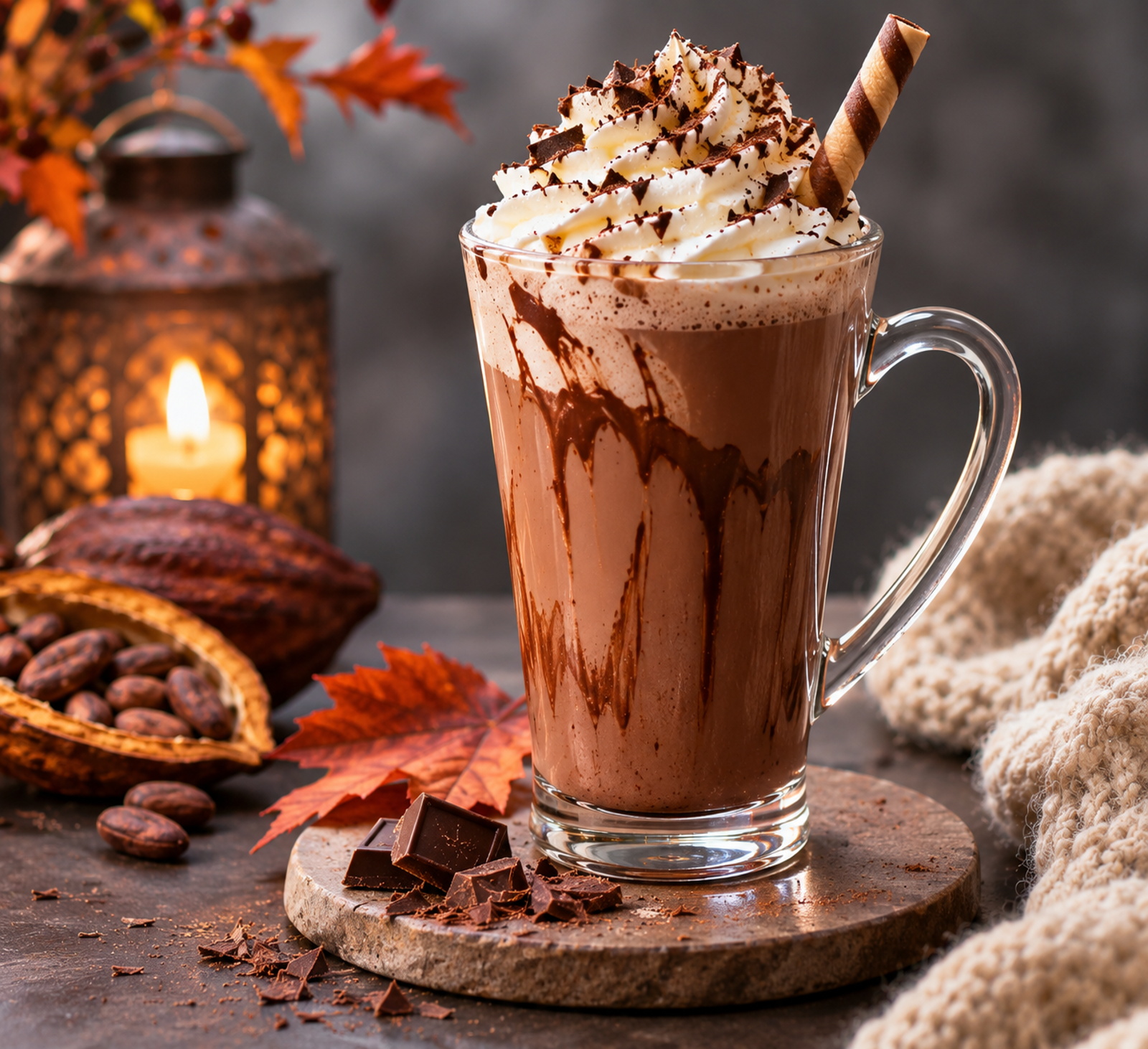
A little chocolate indulgence on a chilly autumn day. AI-generated illustration.
THE HOGAHERO COLUMN
An unexpected journey from cold feet to cocoa beans, exotic flavours and a rather neglected hotel beverage.
Today, I had plenty of ideas for my next article and was still trying to decide which one to write about.
Something serious. Something involving hotels, business decisions and probably a few impressive industry statistics.
But my fingers were cold, my feet were cold, and somewhere between staring at my screen and weighing up my options, I developed an overwhelming desire for a proper cup of hot chocolate.
With whipped cream, of course.
And that was when a rather strange question popped into my head: Why does everyone care where their coffee comes from, but hardly anyone asks about their chocolate?
Coffee Gets All the Attention
Walk into almost any fashionable coffee shop and you’ll find yourself travelling around the world without leaving your chair.
Ethiopian coffee, Colombian coffee, Brazilian coffee, perhaps a carefully selected Thai Arabica from the mountains of Chiang Mai. There are tasting notes, roasting profiles, brewing methods and sometimes explanations so elaborate that ordering a cappuccino feels like enrolling in a university course.
And then there’s hot chocolate.
One lonely line on the menu. No country, no story, no personality. Sometimes it arrives with whipped cream and a marshmallow, presumably to distract us from asking too many questions.
But where did the cocoa come from? And does it really all taste the same?
As it turns out, chocolate has quite a few stories to tell.
A Chocolate Trip Around the World
Madagascar, for example, is known for chocolates with bright, fruity notes, sometimes reminiscent of red berries or citrus. Ecuador is famous for its aromatic Nacional cacao, often associated with floral characteristics, while Ghana produces cacao appreciated for its rich, traditional chocolate flavour.
And then there’s Thailand.
Yes, Thailand produces cacao too. Not just chocolate bars made from imported ingredients, but cacao grown on Thai soil, in regions including Chiang Mai, Chanthaburi, Chumphon and Prachuap Khiri Khan.
Thai chocolate maker Kad Kokoa works with cacao from these different regions, describing flavours ranging from floral and fruity notes in Chiang Mai to tropical fruit characteristics in Chanthaburi, citrus notes in Prachuap Khiri Khan and berry-like flavours in Chumphon.
Suddenly, chocolate sounds considerably more sophisticated than the brown powder sitting next to the coffee machine.
Of course, not every cacao bean from the same country tastes identical. Just as with coffee, the variety, growing conditions, fermentation, drying and roasting all influence the final flavour.
In fact, the International Cocoa Organization even distinguishes between ordinary cocoa and what it calls fine flavour cocoa, valued for its distinctive aromas and complexity.
So chocolate has its own world of origins, craftsmanship and tasting notes. We simply don’t hear nearly as much about it.
Which brings me to another question: Why not?
Imagine Ordering Hot Chocolate Like Coffee
Picture yourself walking into a hotel lounge on a cold afternoon. Instead of the familiar choice between coffee, tea and hot chocolate, the menu offers something a little more adventurous.
Perhaps a Madagascar hot chocolate with bright, fruity notes. Or an Ecuadorian version with delicate floral aromas. Maybe even a Thai single-origin chocolate with hints of tropical fruit.
Wouldn’t you be curious?
I certainly would. In fact, I might be tempted to order a small chocolate tasting flight, just to compare the different origins. Strictly for educational purposes, naturally.
Of course, the chocolate would have to be genuinely sourced from the stated regions, and the preparation would need to allow those distinctive flavours to shine. Drowning everything in sugar rather defeats the purpose.
Although I wouldn’t necessarily object to a little whipped cream.
Hotels and restaurants spend considerable time discussing how to create memorable guest experiences. We talk about elaborate concepts, expensive renovations, new technologies and the latest hospitality trends.
Yet sometimes, a memorable experience can begin with something as simple as a cup of hot chocolate.
A carefully selected chocolate from a particular origin, a short story on the menu, perhaps a seasonal tasting featuring three different countries. Nothing terribly complicated, but certainly more interesting than the usual anonymous cup of cocoa.
Not every guest will care, of course. Some simply want something warm and sweet, and there’s absolutely nothing wrong with that.
But others might discover something they never knew existed. And perhaps they’ll remember that little hotel lounge where they tasted chocolate from Madagascar for the very first time.
Which, when you think about it, is exactly what hospitality is supposed to be about.
And What About My Cold Feet?
Well, I still haven’t written the serious article I originally intended.
Instead, I’ve travelled from Madagascar to Ecuador, Ghana and Thailand without leaving my desk. I’ve discovered that chocolate has considerably more personality than I ever gave it credit for, and I’ve developed a rather ambitious plan to taste hot chocolate from as many origins as possible.
Purely for research purposes, naturally.
Now, if you’ll excuse me, I think it’s finally time to make that hot chocolate.
My feet are still cold.