For years, the hospitality industry believed the staffing crisis could be solved with better recruiting campaigns, higher salaries or stronger employer branding. But across many hotel markets, a different reality is becoming impossible to ignore:
You can’t hire people who cannot afford to live where the jobs are.
From resort destinations in Thailand to ski towns in the Alps, from island properties to major tourist cities, operators are discovering that the real challenge is no longer just finding talent. It is creating the conditions that allow employees to stay.
Housing, transport and everyday stability are quietly becoming some of the most powerful competitive advantages in hospitality.
The hotels winning the talent war are often not the ones offering the highest salaries. They are the ones reducing friction in everyday life.
Hospitality Has Entered the Infrastructure Era
For decades, hospitality recruitment focused heavily on wages, bonuses and career opportunities. Today, many operators are facing a much more practical problem.
Where exactly should employees live?
In many tourism hotspots, rental markets have become nearly impossible for hospitality workers. Apartments are scarce, prices continue to rise and long commuting times are becoming normal.
But this crisis does not only affect major cities or luxury destinations. Rural and suburban hospitality markets are increasingly struggling as well. In many regions, public transportation is unreliable or simply unavailable during early morning or late-night shifts. Employees are forced to drive long distances, often spending a significant part of their income on fuel, transportation and vehicle maintenance.
By the time they arrive at work, many are already exhausted.
Asking a team member to deliver energetic, high-level hospitality after an expensive and stressful 60-minute commute is becoming a losing strategy. The physical and financial pressure drains employees before the first guest is even served.
The result is predictable: restaurants reduce opening hours, hotels leave rooms unsold and existing staff become increasingly overworked.
Many operators still treat this primarily as a labor issue.
In reality, it is increasingly an infrastructure issue.
What Asian Hospitality Markets Understood Earlier
In parts of Asia, many hospitality employers solved this challenge long ago – not through theory, but through operational necessity.
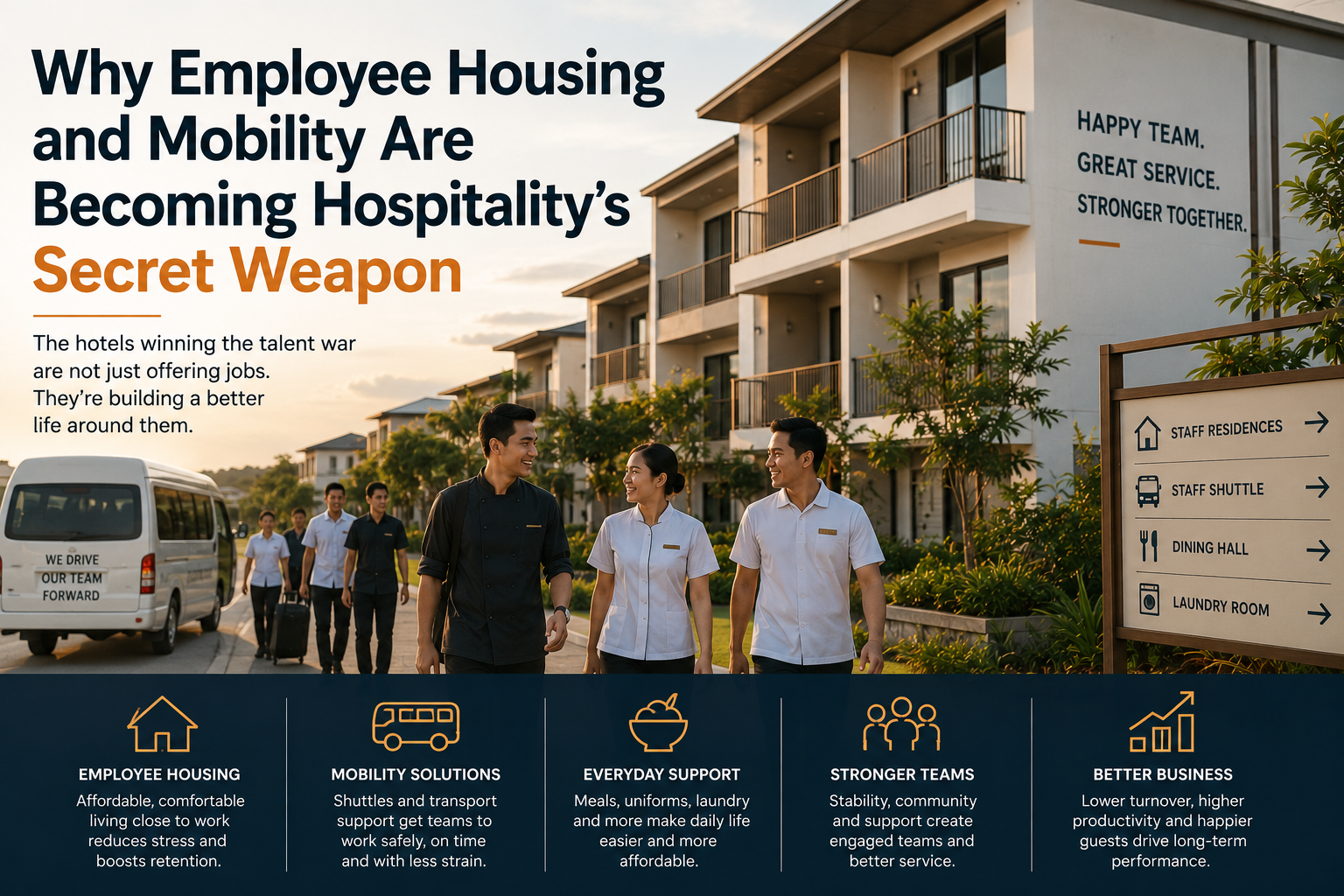
Especially in resort-driven markets such as Thailand, staff housing has long been integrated into hospitality operations. Employee transportation, uniforms, subsidized meals and shared accommodation are often considered standard parts of the employment structure rather than exceptional benefits.
For remote resorts, island destinations or properties far from urban centers, this approach is simply practical. Without transport and housing support, maintaining a stable workforce would be nearly impossible.
Some hotels provide dedicated shuttle buses for employees working late-night or early-morning shifts. Others organize dormitories, staff residences or employer-supported housing close to the property. Uniforms are frequently provided and cleaned by the hotel itself, reducing additional living costs and logistical stress for employees.
Viewed individually, these measures may seem small.
Together, they create stability.
And stability has become one of the most valuable currencies in hospitality employment.
What makes this particularly interesting is that many Asian hospitality markets have treated these systems as part of normal operational budgeting for decades. Staff housing, transportation and support infrastructure are often viewed less as “employee perks” and more as essential operational tools.
That perspective is now slowly spreading into Western hospitality markets as labor shortages intensify.
Employee Housing Is No Longer Just a “Nice Extra”
For many years, staff accommodation was mostly associated with seasonal mountain hotels, cruise ships or remote resorts. Today, it is becoming relevant far beyond those traditional sectors.
Urban hospitality markets are increasingly affected as well.
Hotels may offer competitive salaries, but if employees still spend most of their income on rent or lose hours every day commuting, retention quickly becomes difficult. Recruitment costs rise, turnover increases and operational quality suffers.
Some hospitality companies are now beginning to rethink the entire equation.
Instead of constantly replacing staff, they are investing in the conditions that encourage employees to stay longer.
That may include:
- purchasing or leasing local properties dedicated specifically to employee housing,
- offering below-market rental prices for staff,
- organizing shared housing concepts for seasonal or international workers,
- organizing staff transportation for employees facing long commutes from more affordable surrounding areas,
- subsidizing fuel costs or regional transport passes,
- securing long-term agreements with local landlords,
- or supporting international recruits with relocation and administrative processes.
The conversation is slowly shifting from “How do we recruit faster?” to “How do we create a sustainable workforce?”
That is a very different conversation.
The Hidden Cost of Ignoring Workforce Infrastructure
Many hospitality businesses still calculate staff housing and transportation purely as additional expenses.
What is often ignored are the costs created by instability.
Constant turnover, exhausted employees, rising sick leave, operational stress and declining service quality all carry financial consequences. Recruiting new employees again and again is expensive. Losing experienced team members damages consistency. Burned-out staff rarely create memorable guest experiences.
Hospitality is an energy-driven industry.
And increasingly, employees are arriving at work with their energy already depleted by housing stress, transportation costs and exhausting commutes.
This directly impacts service culture, guest satisfaction and long-term loyalty.
The true cost of weak workforce infrastructure is often hidden inside operational instability.
The Return of the Hospitality Ecosystem
In many ways, the industry is returning to an older operational model.
Historically, hotels and large tourism businesses often provided far more than jobs. They created entire ecosystems around employees – including accommodation, meals, transportation and social structures.
Modern hospitality is rediscovering this logic.
Not because it is nostalgic, but because market conditions increasingly demand it.
The most forward-thinking operators understand that workforce stability directly impacts guest experience, operational consistency and long-term profitability.
A hotel with constant turnover rarely delivers seamless service.
A stable team does.
Why This Matters for the Future of Hospitality
The global hospitality industry is entering a period where operational resilience may matter more than aggressive expansion.
Hotels can invest millions into design, branding and marketing. But if staffing instability continues, operational performance eventually suffers.
This is why employee housing and mobility are becoming more than HR topics.
They are becoming business strategies.
The properties that adapt early may gain a major competitive advantage in the coming years – especially in destinations where affordable housing continues to disappear.
Because the future of hospitality recruitment may not be decided by job ads alone.
It may be decided by who helps employees build a livable life around the job.
Enjoyed this article?
Follow Hogahero on LinkedIn for hospitality insights, market trends and practical ideas shaping the future of hotels, restaurants and tourism businesses.