For decades, the hospitality industry relied on a business model that appeared almost timeless in its simplicity. Hotels generated value by building more rooms, attracting more guests and gradually increasing room rates as markets matured. Restaurants, spas, meeting facilities and retail outlets undoubtedly enhanced the guest experience, yet they were rarely viewed as independent economic pillars. Their purpose was to support the accommodation business, not replace it. In most cases, the financial health of an entire property ultimately depended on one highly volatile product: the overnight stay.
There was nothing inherently wrong with this model. It served generations of hotel owners remarkably well and helped shape one of the world’s largest industries. Yet every successful business model eventually reaches a point where changing market conditions begin to expose its limitations. Hospitality appears to be approaching exactly such a moment.
Construction costs continue to rise in virtually every major market. Labor shortages have become structural rather than cyclical, placing constant pressure on operating margins. At the same time, luxury itself has become increasingly standardized. Infinity pools, wellness centers, sophisticated restaurants and beautifully designed guest rooms remain desirable, but they are no longer rare. From Southern Europe to Southeast Asia, many high-end properties now offer remarkably similar products, making it progressively more difficult for individual hotels to distinguish themselves through facilities alone.
The challenge facing owners today is therefore not primarily one of demand. International travel remains resilient, and many destinations continue to record impressive visitor numbers. The more fundamental question concerns the economic model that supports the asset itself. If selling rooms becomes a less predictable source of growth, what other forms of value can a hotel create?
Success has traditionally been measured through a remarkably small group of indicators. Occupancy, Average Daily Rate and RevPAR remain essential measures of operational performance, but they may no longer describe the full commercial potential of a modern hotel. The properties that outperform over the coming decades may not necessarily be those with the highest occupancy. They may simply be those that discover more ways to generate revenue from the infrastructure they already possess.
Should Every Room Still Be a Hotel Room?
Perhaps the most visible transformation is taking place in the relationship between hospitality and residential real estate. Increasingly, developers are questioning whether every square meter of a hotel should remain dedicated exclusively to short-term accommodation. Across numerous destinations, parts of hotel developments are being sold as branded residences or serviced apartments while remaining integrated into the wider hotel operation.
One example can be found at the Viceroy Snowmass in Colorado, where privately owned residences form part of the overall hospitality concept. Owners retain the flexibility to occupy their homes whenever they choose, while many also participate in professionally managed rental programs during periods of absence.
The significance of this model extends well beyond the initial property sale. Selling residential units provides immediate liquidity, but the commercial relationship continues for years afterwards. Property management generates recurring income, rental management creates an additional business, and permanent residents continue to use restaurants, wellness facilities, concierge services and housekeeping throughout the year. What once depended almost entirely on transient guests gradually evolves into a more diversified source of recurring revenue.
Why Should Only Overnight Guests Use Your Best Facilities?
Hotels invest enormous sums in facilities that often remain surprisingly underutilized. Rooftop terraces, fitness centers, spas and executive lounges are expensive to build and costly to maintain, yet many of these spaces experience long periods of inactivity outside peak guest hours.
Rather than viewing these facilities exclusively as guest amenities, some operators have begun treating them as businesses in their own right. Carefully managed membership programs aimed at local professionals and affluent residents create an entirely different revenue structure. A hotel that attracts local members to its wellness facilities, business lounges or dining concepts is no longer relying solely on seasonal visitor flows. It begins to establish recurring income that is largely independent of tourist arrivals while simultaneously strengthening its relationship with the surrounding community.
What Happens to the Building Between Breakfast and Dinner?
Hotels are unusual commercial assets. Their principal product is consumed overnight, yet the buildings themselves remain fully operational throughout the day. Meeting rooms, restaurants, lounges and generous public spaces frequently experience long periods in which they contribute little to overall revenue despite requiring continuous staffing, maintenance and energy consumption.
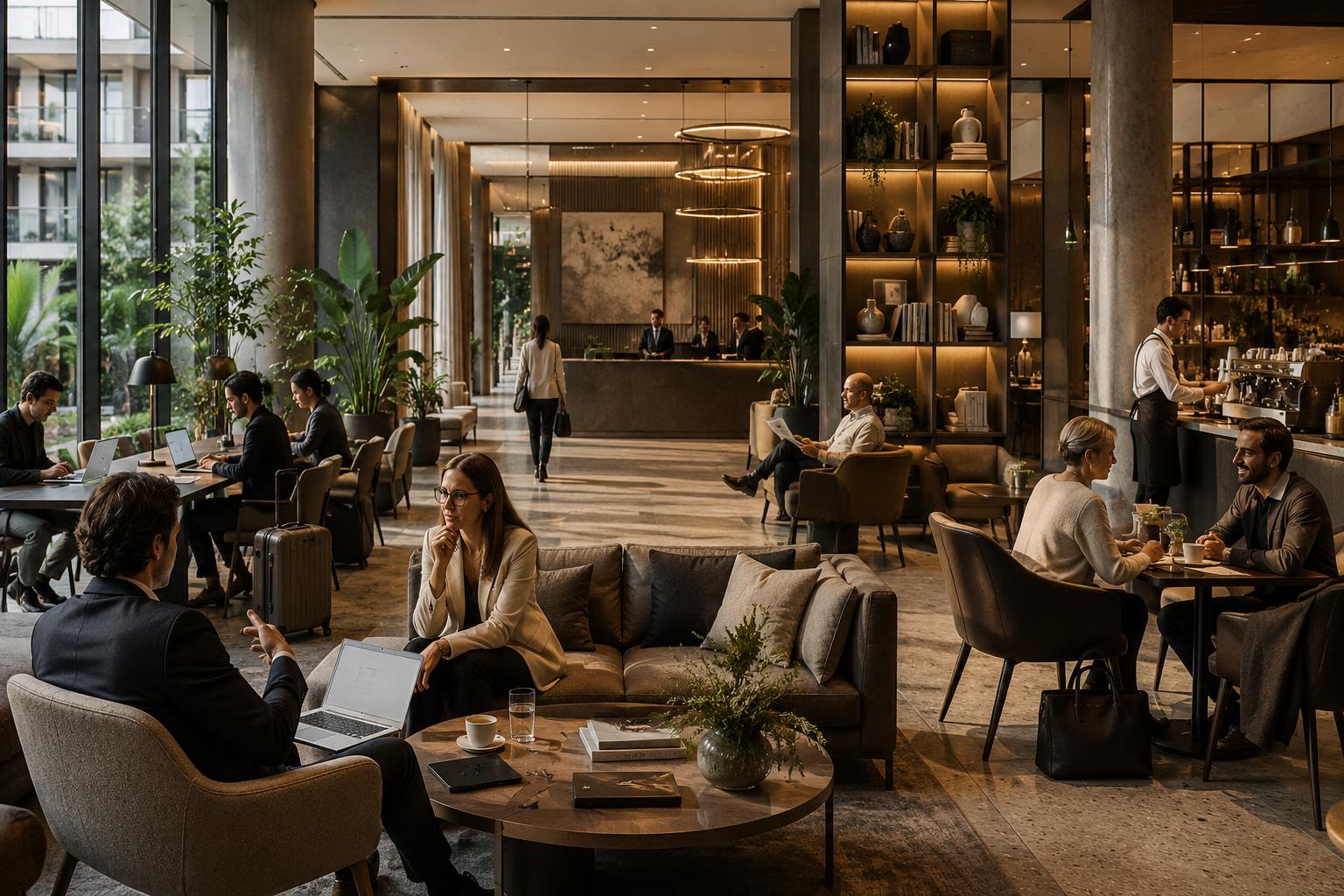
Forward-thinking operators increasingly ask a different question. Instead of accepting these daily fluctuations as inevitable, they consider how the same space might serve different purposes throughout the day. Meeting rooms become flexible business environments. Quiet lounges evolve into professional workspaces. Underutilized areas accommodate podcast studios, private offices or corporate events. The objective is not to change the identity of the hotel, but to allow the same physical space to generate value more than once within a twenty-four-hour cycle.
Could Your Brand Continue to Earn After the Guest Has Left?
The strongest hotel brands have always sold something that extends beyond accommodation. Guests often remember the atmosphere, the design language, the quality of the bedding, the fragrance in the lobby or the rituals that define a particular property long after they have returned home.
Increasingly, operators recognize that these emotional connections represent commercial opportunities. Rather than limiting their relationship with guests to the duration of a stay, they extend it through carefully curated products and experiences. Signature mattresses, exclusive coffee blends, private-label wines, interior collections or culinary masterclasses all represent ways in which a hotel’s identity can continue generating value beyond the physical boundaries of the property.
The objective is not simply to sell merchandise. It is to transform a memorable stay into a longer-term relationship with the brand.
Are You Selling Accommodation—or Access?
Perhaps the most profound shift is taking place at the highest end of the hospitality market. Many affluent travelers no longer choose a destination because of the size of a suite or the quality of a marble bathroom. Those comforts have become widely available across the global luxury sector.
What remains genuinely scarce is privileged access.
Access to places few visitors ever experience. Access to local expertise that cannot easily be booked online. Access to conservation projects, private cultural encounters or highly personalized itineraries that exist outside conventional tourism.
In these cases, the hotel room provides the setting rather than the principal attraction. The guest is paying for knowledge, relationships, trust and curation. The property becomes less a place to sleep and more a gateway to experiences that competitors cannot easily replicate.
A Broader View of Hospitality
None of these developments suggest that occupancy has become irrelevant. Rooms will remain the foundation of the hotel business for the foreseeable future, and operational excellence will continue to matter as much as ever.
What is changing is the way successful owners think about the asset itself.
For decades, hotels have largely been evaluated according to how efficiently they sold overnight stays. Increasingly, however, the most resilient businesses may be those that regard accommodation as only one component of a far broader commercial ecosystem. Residential living, membership communities, flexible workspaces, retail products and carefully curated experiences all demonstrate that a hotel can generate value in far more ways than simply selling another room for another night.
The next chapter of hospitality may therefore not be defined by building more keys or achieving marginal improvements in occupancy. It may be defined by a much more fundamental shift in perspective. The hotels that thrive will not necessarily be those that welcome the greatest number of guests. They may simply be the ones that discover the greatest number of reasons for people to spend money with them.
Share Your Perspective
Hospitality is evolving faster than ever, but meaningful industry conversations rarely begin with traditional advertising.
At Hogahero, we collaborate with hotels, restaurants, hospitality groups, developers, architects, consultants, technology providers, suppliers and industry experts to publish thoughtful sponsored articles that inform, inspire and contribute to the wider hospitality conversation.
Whether you are launching a new concept, presenting an innovative business model, introducing a new development or sharing practical expertise, we help transform commercial knowledge into high-quality editorial content that delivers value to our international audience.
Interested in collaborating? Visit our Partner with Us page or get in touch with our editorial team.