Across global hospitality markets, a clear structural shift is emerging. The performance gap between modern hotels and aging assets continues to widen, creating increasing pressure on older properties while opening new opportunities for buyers and turnaround investors.
In destinations ranging from Southern Europe to Southeast Asia, operators report a consistent pattern. Newly developed, lifestyle-oriented hotels are capturing demand, while older budget and midscale properties struggle to maintain occupancy, pricing power and relevance. What was once considered a stable, price-driven segment is now facing operational strain and rapidly evolving guest expectations.
For many owners, this shift is no longer primarily driven by tourism cycles. Instead, it is rooted in the age of the asset, the rising cost of required upgrades and the realities of operating in an increasingly competitive global market.
Modern Supply Reshaping Guest Expectations
In markets with significant development activity over the past decade, newly built hotels have quietly redefined what guests consider acceptable. Contemporary architecture, efficient layouts, modern technology and a sense of freshness are no longer premium features. They have become the baseline.
Guests who once accepted older, simpler rooms are now making different decisions. Even at a slightly higher price point, modernity and design often take priority. This shift places older independent hotels under increasing pressure, particularly when surrounded by competitors offering stronger design, better online reputations and updated amenities.
Even in destinations reporting healthy visitor numbers, many operators describe challenging trading conditions. The issue is rarely demand itself, but rather the growing mismatch between an aging product and current guest expectations.
Rising Renovation Needs and the Cost Reality
Hotel aging rarely unfolds gradually. It accelerates when multiple systems reach the end of their lifecycle at the same time. Guest rooms, bathrooms, flooring, air-conditioning systems, public areas and back-of-house infrastructure tend to deteriorate in parallel. What once appeared as manageable refurbishment quickly evolves into a full-scale capital investment requirement.
At the same time, construction costs, labour and energy-related upgrades have increased significantly across global markets. Required capital expenditure now grows faster than room revenue in many cases, creating a widening gap between operational income and investment needs.
Deferred maintenance compounds the problem. Operating costs rise, margins tighten and the ability to reinvest declines. For many hotel owners, this marks the point where continuing operations becomes increasingly difficult without external capital or a strategic exit.
Financial Pressure and the Expanding CapEx Gap
These operational challenges are further intensified by financial conditions. Higher interest rates increase debt service obligations and complicate refinancing. Owners approaching loan maturities often face stricter lending conditions, particularly when assets show renovation backlogs or declining performance indicators.
In many cases, financial institutions react before the market visibly shifts. Valuations are adjusted, covenants tightened and risk profiles reassessed. What once appeared stable can quickly become unsustainable when cash flow no longer supports both daily operations and long-term investment requirements.
This dynamic is accelerating the number of hospitality businesses entering the market, including properties whose owners had not initially planned to sell a hotel or exit the sector.
A Quiet but Significant Generational Shift
Beyond financial and operational pressures, generational change is becoming an increasingly important factor. Many small and mid-market hotels were developed and operated by families with strong local ties and long-term commitment. Today, succession is no longer guaranteed.
Younger generations often pursue different careers, relocate internationally or lack the interest in managing an operationally demanding asset. What was once a long-term family business can gradually become a burden.
In these situations, properties frequently enter a phase of stagnation. Investment is postponed, positioning weakens and competitiveness declines. Some hotels remain partially or fully unused for extended periods as decisions are delayed.
Because many long-standing owners prefer discreet and controlled transitions, a significant portion of these assets never appears in public listings. For buyers, particularly those experienced in hospitality investment, this creates access to opportunities that remain largely off-market.
A Structural Shift Creating New Opportunities
The convergence of aging infrastructure, rising capital expenditure requirements, financial pressure and generational transition is creating a unique market phase. Many older hotels are approaching a point where ownership change becomes increasingly likely.
These assets are often located in established destinations with proven demand fundamentals. However, due to postponed investment, they underperform relative to their potential. This gap creates opportunities for buyers who can introduce capital, reposition the concept and apply operational discipline.
For investors looking to buy a hotel, repositioning strategies can unlock significant value where others see decline.
Repositioning, Conversion and Strategic Direction
Not every aging hotel can be revitalised through incremental improvements. In many cases, a more fundamental repositioning or conversion is required.
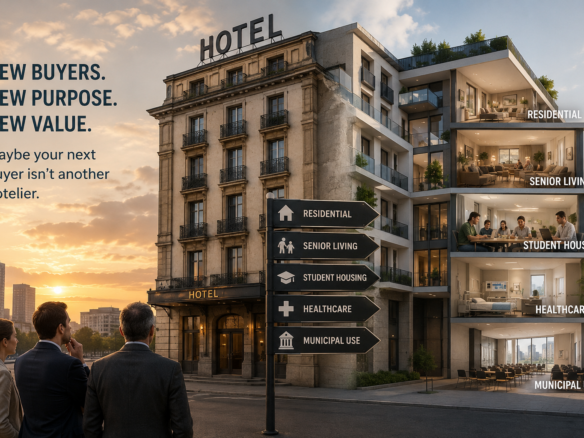
Transforming a dated midscale property into a contemporary lifestyle hotel can attract entirely new guest segments. In markets with strong residential demand, alternative uses such as serviced apartments, co-living concepts, student housing or senior living may offer more stable long-term returns.
Brand affiliation can also play a decisive role. Independent hotels with limited distribution often experience immediate performance improvements when aligned with established brands. Access to global reservation systems, loyalty programs and updated design standards can drive demand even before major renovations are completed.
Sustainability as a Defining Investment Factor
Regulatory and environmental requirements are adding another layer of complexity. Many aging hotels require significant upgrades simply to meet current or upcoming compliance standards.
Improvements in insulation, energy systems, lighting and water efficiency are capital-intensive but increasingly unavoidable. For long-term owners, these investments can represent a barrier. For professional investors, they can become part of a structured value creation strategy.
Access to green financing and sustainability-linked funding can lower the cost of capital, making these transformations more viable. As ESG criteria continue to influence investment decisions, the gap between compliant and non-compliant assets will continue to widen.
What Buyers and Owners Should Consider
Turnaround opportunities in hospitality can offer strong returns, but they require careful analysis. Investors need to evaluate total renovation costs, location fundamentals, positioning potential and regulatory frameworks that will shape long-term competitiveness.
For owners, the key question is shifting. It is no longer only about whether a hotel can continue operating, but whether it can realistically compete in a market defined by modern standards and evolving guest expectations.
In many cases, selling a hotel at the right moment may preserve more value than delaying necessary decisions.
A Market Entering Its Next Phase
Across global hospitality markets, aging hotels are approaching a structural inflection point. Rising standards, increasing competition, financial constraints and generational change are exposing underlying weaknesses that have developed over time.
For some owners, this environment creates pressure. For others, it creates a window of opportunity to exit strategically. For buyers and turnaround investors, it offers access to assets with strong fundamentals but unrealised potential.
As the market continues to evolve, value will increasingly shift toward those who are able to rethink, reposition and redevelop hospitality assets in line with contemporary expectations.
Looking to buy, sell or position a hospitality business?
Hogahero connects curated hospitality assets, operators and opportunities.
Create a listing or explore opportunities