
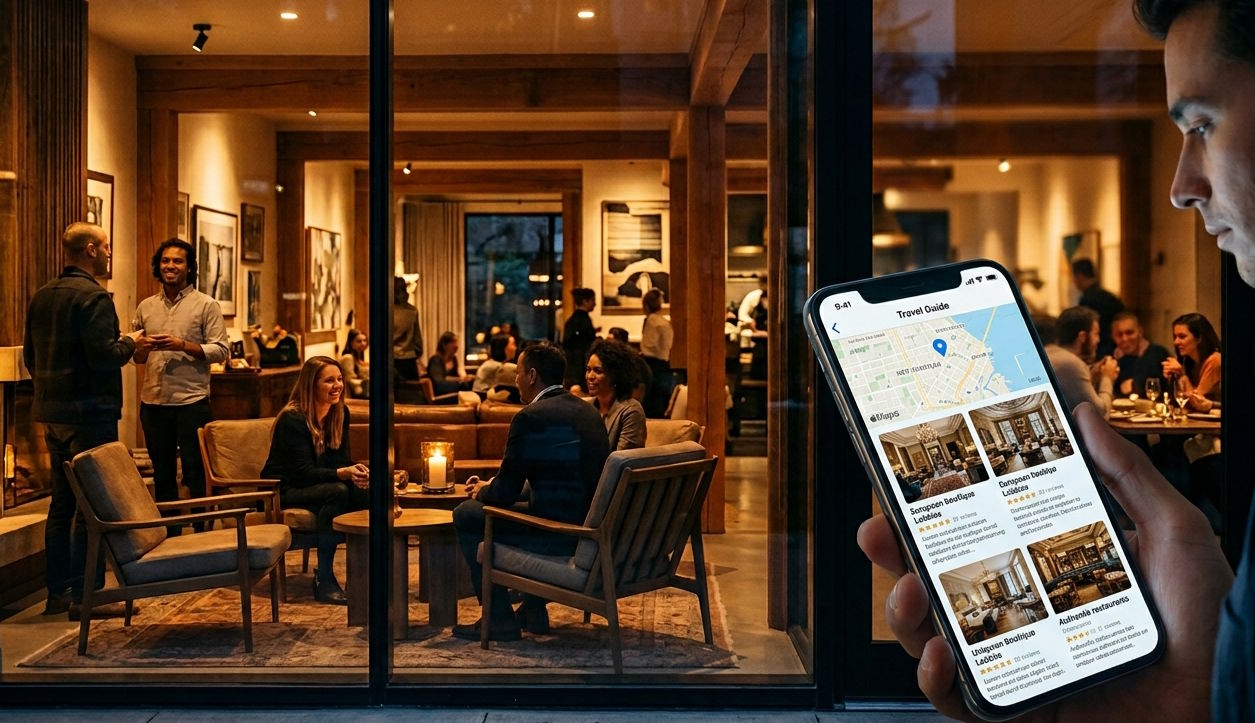
The hospitality industry has never invested more heavily into atmosphere, branding and guest experience. Hotels redesign rooms, restaurants rebuild interiors, cafés develop carefully curated concepts and operators across the industry increasingly position themselves around identity, storytelling and experience-driven travel.
At the same time, however, many hospitality businesses are beginning to look surprisingly similar online.
Scroll through booking platforms, delivery apps or map results long enough and the pattern becomes difficult to ignore. Similar photography. Similar descriptions. Similar positioning language. Boutique. Lifestyle. Authentic. Premium. Between them, rankings, discounts and platform filters designed to help users compare hundreds of businesses within seconds.
The contradiction is becoming increasingly visible: Hospitality continues to sell individuality, while digital platforms increasingly reward standardization.
From Street Visibility to Search Visibility
For decades, hospitality businesses relied heavily on physical visibility. A busy street, a beautiful terrace, a lively dining room or a prime beachfront location naturally attracted attention. Guests discovered places while walking through cities, driving past properties or hearing recommendations from other travelers.
Today, that process often begins much earlier.
Modern guests search before they arrive. Restaurants are selected through Google Maps, hotels through booking platforms, cafés through Instagram feeds and delivery apps. In many cases, the first interaction with a hospitality business no longer happens at the property itself, but on a smartphone screen.
That shift is quietly changing how hospitality itself is perceived.
A restaurant may offer extraordinary atmosphere in reality while appearing online beside hundreds of nearly identical listings using the same platform photography, the same review structures and the same algorithmic filters. A boutique hotel may invest heavily into architecture, service and guest experience while digitally competing inside the same visual grid as budget rooms, hostels and standardized chain properties.
A property can still feel highly distinctive in reality while appearing increasingly generic once filtered through systems designed primarily around speed, comparison and algorithmic visibility.
When Platform Logic Starts Shaping Hospitality Itself
The growing influence of digital platforms does not only affect visibility. Increasingly, it also begins influencing how hospitality businesses present themselves in the first place.
Concepts that perform well inside platform systems naturally receive more attention, more clicks and ultimately more bookings. Over time, this creates pressure toward adaptation. Photography becomes more standardized, descriptions more algorithm-friendly and positioning increasingly shaped around what performs well digitally rather than what necessarily creates the strongest real-world experience.
The paradox is that businesses often become more visually interchangeable precisely because they are trying to remain visible inside the same systems.
This is particularly visible in delivery ecosystems, where convenience and speed dominate platform behavior. Restaurants built around operational simplicity and highly recognizable products often gain visibility more easily than concepts driven primarily by atmosphere, service or culinary identity.
A similar pattern is emerging in hospitality.
Hotels increasingly compete inside environments where emotional differentiation becomes difficult to communicate. Architecture, atmosphere and service quality are reduced to thumbnails, filters and rankings designed for rapid comparison. As a result, highly distinctive properties can gradually begin to look surprisingly similar online, despite offering completely different guest experiences in reality.
The long-term risk is not necessarily declining quality, but the gradual erosion of visible differentiation.
The Digital Layer Is Aging Faster Than the Hospitality Itself
Since Covid, many hospitality businesses have focused heavily on stabilizing operations again. Staff shortages, rising costs, energy prices and tighter margins pushed attention back toward the daily realities of running hotels and restaurants. Rooms were renovated more carefully, menus simplified, teams reduced and investments prioritized far more selectively than before.
At the same time, many businesses quietly stopped evolving their digital presence with the same intensity.
Photography became outdated. Google profiles remained incomplete. Websites stayed online for years without meaningful updates. Social media turned inconsistent. In many cases, operators simply focused on keeping the actual business running well — assuming the digital side could wait.
The problem is that modern hospitality discovery increasingly happens exactly there.
Guests often encounter the digital version of a business long before they encounter the real one. And while many independent hotels and restaurants may still deliver strong real-world experiences, their online presence frequently communicates something very different: inconsistency, invisibility or generic positioning.
In some cases, the hospitality itself improved while the digital layer surrounding it simply failed to evolve at the same pace.
Why This Matters for Buyers and Investors
For buyers and investors, this shift creates an increasingly important dynamic.
Not every struggling hospitality business suffers from weak operations or poor guest experience. In some cases, the core issue may simply be that the business no longer communicates its value effectively inside modern discovery systems.
A hotel can be operationally strong while looking digitally forgettable. A restaurant can have loyal guests, strong food and genuine atmosphere while remaining almost invisible online because its digital presentation no longer reflects the actual quality of the experience itself.
That changes how hospitality assets increasingly need to be evaluated.
Location still matters. Product quality still matters. But visibility itself is gradually becoming part of the commercial equation. Businesses that fail to remain visible inside Google, maps, booking systems and digital search environments risk disappearing from consideration long marriage guests ever encounter the actual hospitality experience behind them.
Over time, this can also weaken brand equity itself. Guests increasingly build loyalty toward the platforms they book through rather than toward the hospitality businesses behind them. The customer relationship gradually shifts away from the operator and toward the intermediary controlling visibility, discovery and transaction flow.
For some operators, the required transformation may therefore be less operational than perceptual.
More Technology Is Not Necessarily the Solution
The industry’s response to digital disruption has often been more technology: more booking systems, more platforms, more integrations and more apps.
Yet the deeper challenge may not be technological at all.
Hospitality already has enough systems designed to maximize efficiency, comparison and transaction speed. What increasingly seems to be missing is differentiation. Many businesses have invested heavily into websites and booking engines that guests never even reach because the decision was already made earlier inside Google Maps, booking filters or platform rankings.
Interestingly, some independent operators are beginning to respond by investing less into platform conformity and more into recognizable identity. Stronger direct channels, original content, distinctive storytelling and carefully curated positioning are increasingly becoming part of the competitive strategy again – particularly for hospitality concepts built around atmosphere, personality and long-term guest loyalty rather than pure transaction volume.
Perhaps the next phase of hospitality will revolve less around becoming more digital and more around becoming recognizable again.
Because the real risk for many hospitality businesses is no longer invisibility alone. It is becoming digitally visible while gradually losing the ability to appear distinctive at all.
For independent hotels, restaurants and hospitality concepts, digital visibility is increasingly becoming part of the guest experience itself. Operators looking for support around Google visibility, positioning or platform-driven discovery systems are welcome to contact Hogahero for further information or industry connections.