
Why Digital Tipping Is Becoming a Critical Factor in Hospitality Operations and Valuation
Introduction – A Small Interface with Systemic Impact
Digital tipping may appear as a minor feature within the payment process. In reality, it has become a structural element of modern hospitality operations.
As cashless payments replace traditional transactions, tipping is no longer an informal gesture. It is embedded in systems, processed through accounts, and shaped by software design.
This shift is redefining not only guest interaction, but also staff dynamics, operational transparency, and ultimately the value of hospitality businesses.
A Global System Without Cultural Alignment
Tipping has never followed a universal standard.
In some markets, it is essential to staff income. In others, it remains symbolic or even culturally inappropriate.
Digital payment systems, however, apply standardized tipping interfaces across regions. Percentage-based prompts appear regardless of local norms, creating friction between technology and culture.
For operators, this introduces a new layer of complexity. A system designed for one market can quickly become misaligned in another, affecting guest perception and satisfaction.
The Psychology of the Interface – Nudging or Manipulation
Digital tipping is no longer just a question of generosity, but of interface design.
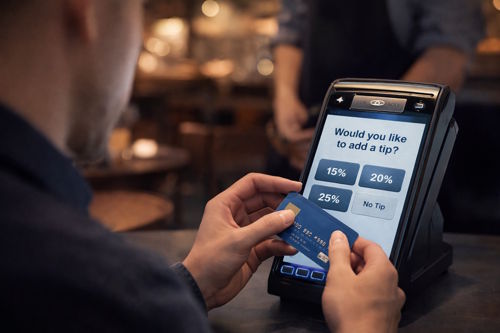
Default percentages, button placement, and visibility all influence decision-making. When suggested tips start above local norms, guests may perceive the system as manipulative rather than service-oriented.
Equally relevant is the “opt-out” dynamic. Requiring guests to actively select “no tip” in front of staff introduces social pressure. While this may increase short-term tipping volume, it risks long-term damage to guest trust and return behavior.
The distinction between subtle nudging and aggressive design becomes critical. In hospitality, where emotional experience defines value, poorly designed interfaces can undermine the very relationship they aim to monetize.
The Shift from Gratitude to Interface Pressure
The move from cash to screen has fundamentally changed the psychology of tipping.
What was once a private, voluntary gesture now becomes a visible decision within a structured checkout process. Guests are prompted to choose predefined percentages, often in the presence of staff.
While some operators report increased tip volumes, the long-term effect is more complex. Repeated exposure to digital prompts can lead to resistance, reduced tipping behavior, or avoidance of certain establishments.
In an industry built on emotional connection, transforming the final moment of a guest experience into a transactional decision carries reputational risk.
Operational Complexity and Financial Implications
Digital tipping introduces administrative and financial challenges that extend beyond guest interaction.
Unlike cash tips, digital gratuities pass through the business infrastructure. This requires clear accounting separation between revenue and tips, particularly in jurisdictions with strict tax regulations.
In addition, payment providers often apply transaction fees to the entire amount, including the tip. This creates a structural decision for operators: absorb the cost or pass it on to staff.
At the same time, system design influences internal equity. Digital tips are frequently assigned to the staff member logged into the terminal, reinforcing disparities between front-of-house and back-of-house teams.
In a labor-constrained market, such imbalances can directly affect retention and operational stability.
Digital Tipping as a Labor Strategy
Tipping systems are no longer isolated operational details. They have become a central component of labor strategy.
In a market defined by staff shortages, perceived fairness often outweighs marginal wage differences.
Systems that exclude kitchen staff or create income disparities can weaken team cohesion. Conversely, well-structured tip pooling and transparent distribution models can significantly improve retention, motivation, and operational stability.
For many operators, a fair tipping system is no longer an add-on – it is a competitive advantage in attracting and retaining talent.
Data as an Operational Asset
One of the most underestimated aspects of digital tipping is the data it generates.
Tipping behavior can be analyzed across shifts, service teams, and transaction types. This allows operators to identify patterns, measure service performance, and move beyond intuition-based management.
Used correctly, tipping data becomes a form of operational intelligence, supporting more informed decisions around staffing, training, and service design.
The Hidden Cost of Speed
In fast-paced hospitality environments, speed is a critical performance metric.
In fast-casual or high-volume concepts, digital tipping prompts can introduce friction at the point of payment. Additional decision steps slow down transaction flow, reduce throughput, and impact revenue during peak periods.
This creates a direct trade-off between maximizing individual tip potential and maintaining operational efficiency.
For operators, tipping design must therefore be aligned not only with guest psychology, but also with the realities of service speed.
Transparency, Compliance, and Risk Exposure
As tipping becomes system-driven, regulatory complexity increases.
In many jurisdictions, tips are only considered tax-free when they are directly transferred from guest to employee. Once processed, distributed, or controlled by the business, they may be reclassified as taxable income.
This creates potential exposure to payroll taxes, social security contributions, and retrospective claims.
For buyers, such risks become highly relevant during due diligence. Unclear structures, missing documentation, or non-compliant systems can directly impact valuation and deal security.
For sellers, transparent, audit-proof tipping systems are no longer optional. They are a prerequisite for credibility.
Alternative Models – Moving Beyond Tipping
The increasing complexity of digital tipping has led some operators to rethink the model entirely.
In certain segments, particularly in higher-end hospitality, tipping is being replaced by service-inclusive pricing or structured service charges.
These models aim to eliminate friction at the point of payment, create predictable income structures for staff, and reduce administrative complexity.
While not universally applicable, they highlight a broader shift: tipping is no longer the only way to structure service compensation.
Impact on Business Value and Transactions
Digital tipping structures are increasingly relevant in hospitality transactions.
For buyers, poorly documented systems introduce uncertainty around compliance, staff expectations, and operational risk.
For sellers, structured, transparent systems enhance credibility, reduce friction in negotiations, and contribute to a more stable asset profile.
In this context, tipping moves from an operational detail to a component of business valuation.
Conclusion – From Clueless to Strategic Design
Digital tipping has exposed a structural gap in hospitality operations.
What once functioned as an informal practice now requires intentional design, clear policy, and strategic alignment with business goals.
Operators who rely on default systems risk creating friction, inequity, and compliance exposure.
Those who actively design their tipping frameworks – balancing fairness, transparency, cultural context, and operational efficiency – move from reactive implementation to strategic control.
In a cashless environment, the question is no longer whether tipping exists, but how it is structured.
The difference between “clueless” and competitive lies in understanding that even the smallest interface can shape the entire business.
Looking to buy, sell or position a hospitality business?
Hogahero connects curated hospitality assets, operators and opportunities.
Create a listing or explore opportunities