Featured image: AI-generated conceptual illustration.
As the hospitality industry invests in futuristic resorts, sophisticated wellness concepts, and ambitious new developments, historic buildings offer a compelling alternative. Their transformation into distinctive hotels reveals how architectural heritage, commercial vision, and contemporary hospitality can create destinations with an identity that new construction cannot easily replicate.
The global hospitality industry continues to reinvent itself through architectural innovation, technology, and evolving guest expectations. Luxury resorts are becoming increasingly elaborate, wellness destinations are expanding into longevity and preventive health, and developers are investing in concepts designed to distinguish themselves in competitive markets. Across established destinations and emerging tourism regions, new hotels promise exceptional design, personalized experiences, and sophisticated facilities.
At the same time, remarkable buildings with decades or even centuries of history remain vacant or underused. Former monasteries, industrial factories, historic schools, railway buildings, country estates, and once-grand residences have often outlived their original purposes. Some have deteriorated through years of neglect, while others remain structurally sound but lack a viable commercial function.
For hospitality investors and developers willing to look beyond conventional construction, these properties can represent extraordinary opportunities. Their architecture, location, cultural significance, and individual histories may provide the foundation for hospitality concepts that would be difficult to reproduce in a newly constructed building.
This approach, known as adaptive reuse, involves converting existing structures to accommodate new functions while retaining meaningful elements of their original character. Within hospitality, it has produced everything from intimate boutique hotels and rural retreats to internationally recognized luxury properties.
The most compelling projects demonstrate how architectural preservation and commercial ambition can complement one another. They transform buildings that have lost their original purpose into destinations that attract visitors, support local economies, and contribute to the identity of their surroundings.
The Enduring Appeal of Historic Architecture
Contemporary hotel design has achieved remarkable levels of sophistication. Modern buildings can offer expansive suites, seamless technology, advanced climate control, and carefully planned wellness environments. Yet even the most accomplished architectural project cannot immediately acquire the historical identity of a building that has evolved over generations.
A former monastery reflects the traditions and daily routines of its original community. An industrial building may retain exposed brickwork, iron columns, oversized windows, or machinery associated with its manufacturing past. A historic residence can reveal the craftsmanship, architectural preferences, and social history of an earlier period.
These characteristics establish a relationship between the property and its surroundings, giving guests an opportunity to experience a destination through its architectural heritage.
For independent hotels, this individuality can provide a meaningful competitive advantage. While international brands benefit from established distribution networks, loyalty programs, and operational consistency, smaller properties often distinguish themselves through personal service, distinctive design, and a strong sense of place.
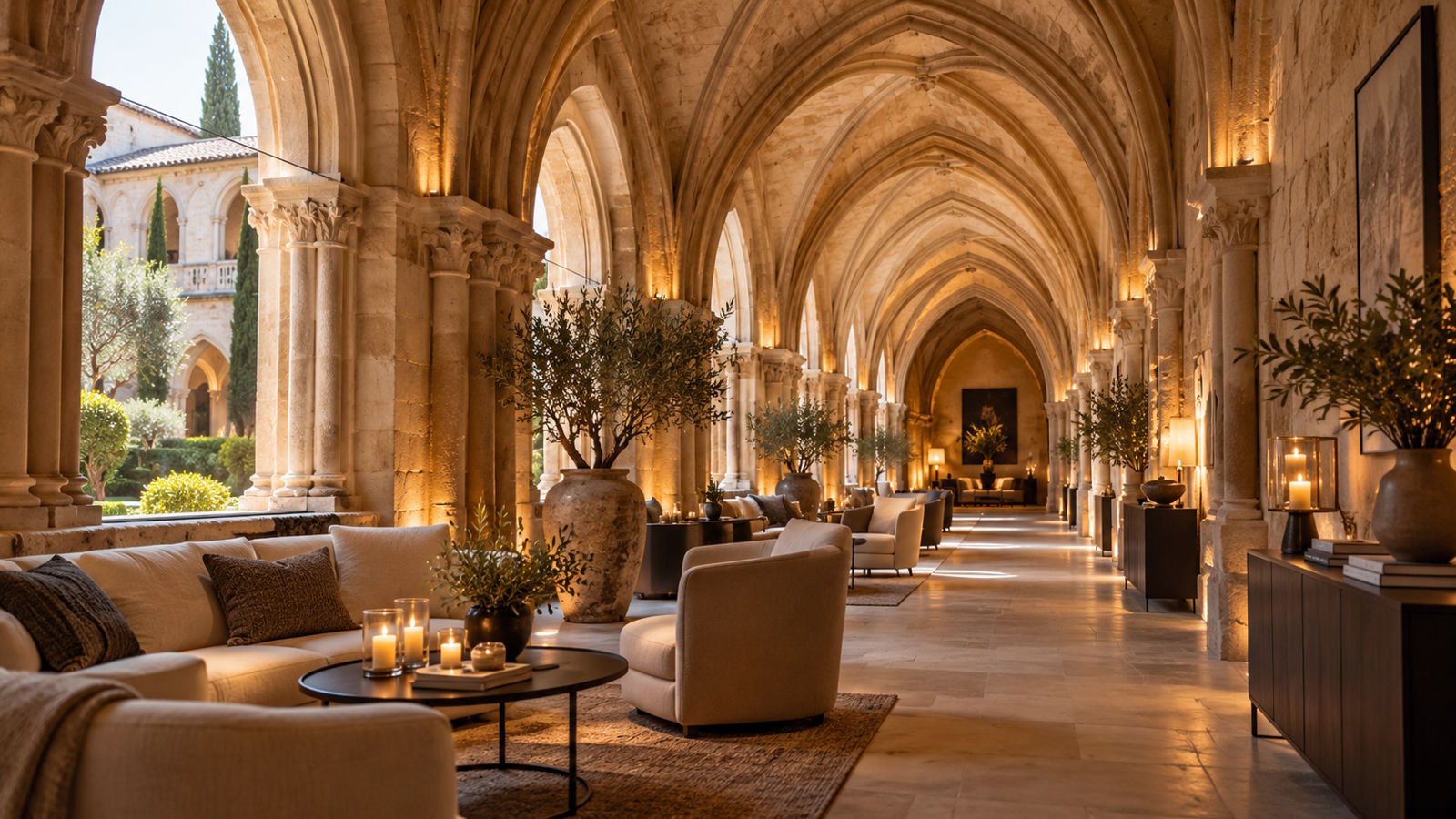
A carefully restored building can support this positioning. Its original features may influence the interior design, the atmosphere of public spaces, and the hospitality concept best suited to the property. A former convent with enclosed gardens and quiet corridors, for example, may lend itself naturally to a retreat centered on relaxation, while an industrial warehouse with generous ceiling heights could provide the setting for an urban lifestyle hotel.
The opportunity lies in understanding which elements of the building’s identity can contribute meaningfully to its new commercial purpose while preserving the qualities that make the property distinctive.
From Historic Property to Hospitality Investment
Recognizing the Commercial Opportunity
The investment potential of adaptive reuse begins with the relationship between the existing property and the hospitality concept that could be developed within it.
Historic buildings sometimes occupy locations that would be difficult or prohibitively expensive to secure for new construction. They may stand in established city centers, historic neighborhoods, prominent waterfront locations, or rural settings with mature gardens and extensive grounds. Their architectural features can also represent substantial value, particularly where reproducing comparable craftsmanship or structural details would involve significant expense.
These advantages can support differentiated positioning within the hospitality market. A boutique hotel with a distinctive architectural identity may appeal to travelers who prioritize individuality, cultural experiences, or privacy over standardized accommodation.
For developers, the opportunity extends beyond creating another commercially successful property. Restoring a neglected landmark can establish a reputation for architectural vision, cultural responsibility, and the ability to recognize potential where others see limitations. Such projects may attract attention from design publications, hospitality professionals, and local communities, creating recognition that extends well beyond the hotel’s opening.
While new developments frequently compete through scale, technology, and increasingly elaborate facilities, a thoughtfully restored historic building can distinguish itself through an identity that already exists. When the location, concept, and market demand align, this individuality can become an important commercial asset.
The Investment Behind the Transformation
Converting a historic building into a hotel requires a different approach to development planning than constructing a property from the ground up.
The acquisition price of an abandoned school, former factory, or historic residence may appear attractive compared with the cost of acquiring land and developing a new hotel. However, restoration budgets must account for the building’s physical condition, applicable regulations, and the infrastructure required for contemporary hospitality operations.
Structural repairs, roof restoration, modern plumbing and electrical systems, climate control, accessibility, and fire protection can represent substantial investments. Heritage restrictions may also influence the design process, particularly where historically significant features must be preserved.
These requirements should be assessed early through structural surveys, architectural studies, and realistic cost planning. An experienced project team can often identify creative solutions that preserve the building’s character while improving operational efficiency.
Financial projections should consider the achievable room inventory, average daily rate (ADR), occupancy expectations, operating costs, and the potential contribution of restaurants, events, or other facilities. The objective is to develop a concept whose commercial performance justifies the investment required.
Exploring Grants and Financial Incentives
Another consideration worth exploring is the availability of public funding and financial incentives. Depending on the country, location, and heritage status of the property, developers may qualify for restoration grants, tax incentives, energy-efficiency programs, or regional development support.
In some cases, these mechanisms can help offset the additional costs associated with preserving historically significant buildings. Certain programs may also encourage the revitalization of vacant properties or support tourism development in economically disadvantaged regions.
Eligibility, funding conditions, and application deadlines vary considerably, making early consultation with local heritage authorities, economic development agencies, and specialist advisers an important part of project planning.
For investors prepared to navigate the process, combining private capital with appropriate restoration or sustainability incentives may improve the financial feasibility of a project that would otherwise appear challenging.
Historic Buildings Reimagined: Four Hospitality Projects
The diversity of adaptive reuse becomes particularly evident when examining completed hotel developments. From former prisons and religious buildings to industrial complexes and architectural landmarks, these properties demonstrate how historical environments can accommodate contemporary hospitality while retaining the character that makes them distinctive.
The Liberty, Boston: A Former Prison Becomes a Luxury Hotel
The Liberty in Boston, Massachusetts, occupies the former Charles Street Jail, a building originally completed in 1851. Its transformation into a luxury hotel preserved significant architectural elements, including the dramatic central atrium, historic ironwork, and features associated with the property’s original purpose.
The hotel incorporates this unusual history into its identity while providing contemporary accommodations, dining, and event facilities. The conversion uses the building’s architectural character to distinguish the property within Boston’s hotel market, allowing guests to experience its history in a setting designed around modern comfort.
With 298 rooms and suites distributed across the historic structure and a newer addition, The Liberty demonstrates that adaptive reuse is not restricted to small independent hotels. Large-scale hospitality operations can integrate preserved architecture with modern facilities when design and operational requirements are carefully coordinated.
The property’s restaurants, bars, and event spaces also illustrate how a historically distinctive building can accommodate multiple revenue-generating activities beyond overnight accommodations.
August, Antwerp: Contemporary Hospitality Within a Former Convent
In Antwerp, Belgium, the former Augustinian convent has been transformed into August, a design-led hotel developed with Belgian architect Vincent Van Duysen.
The property comprises 44 rooms and suites, complemented by a restaurant, bar, wellness facilities, and landscaped gardens. Its architectural approach emphasizes the relationship between the historic structure and contemporary interventions, retaining the atmosphere of the former religious complex while adapting its spaces for modern hospitality.
The building’s original purpose provides an appropriate foundation for the hotel’s positioning. Enclosed gardens, quiet corridors, and restrained architectural details contribute to an environment associated with privacy, reflection, and tranquility.
This connection between historical identity and contemporary use is an important consideration for developers. A building may be most successful when its original characteristics support the intended guest experience, reducing the need to impose an unrelated concept upon the existing architecture.
August illustrates how an intimate property can establish a distinctive market position through architectural quality, thoughtful restoration, and a coherent hospitality philosophy.
Hotel Emma, San Antonio: Industrial Heritage as a Hospitality Destination
Hotel Emma in San Antonio, Texas, occupies a former 19th-century brewhouse within the historic Pearl district. The 146-room hotel retains important elements of the building’s industrial character, creating a luxury hospitality environment closely connected to the area’s manufacturing history.
The property’s significance extends beyond the conversion of a single building. Its location within the wider Pearl district places it among restaurants, retail businesses, cultural activities, and public spaces that have contributed to the area’s transformation into a mixed-use destination.
For hospitality investors, this broader context is particularly relevant. A hotel can benefit from an established or emerging neighborhood identity, while its accommodations, restaurants, and public facilities may contribute to the district’s economic activity.
Industrial conversions can be especially suitable for such concepts because their generous proportions often accommodate substantial public areas, distinctive restaurants, and flexible event spaces.
Hotel Emma demonstrates how industrial heritage can become a central element of both hotel branding and wider destination development, particularly when the property forms part of a thoughtfully planned urban environment.
St. Pancras London: Restoring an Architectural Landmark
The historic hotel building at London’s St. Pancras originally opened as the Midland Grand Hotel in 1873. Designed in the Gothic Revival style, it formed part of the remarkable architectural ensemble associated with St. Pancras railway station.
Following the hotel’s closure in 1935, the building served other purposes before an extensive restoration enabled its return to hospitality in 2011. Today, the property operates as St. Pancras London, Autograph Collection, combining restored historic interiors with contemporary hotel facilities.
The project illustrates the possibilities of heritage-led hospitality development on a significant architectural scale. Protected historic features, modern building services, and contemporary guest expectations were brought together within a property whose cultural importance extends beyond its commercial use.
Although projects of this scale require substantial capital and specialist expertise, they demonstrate how architectural preservation can establish a commercially productive future for a landmark building.
For smaller developers, the underlying principle remains relevant: a property’s historical identity can represent an enduring asset when preservation and commercial strategy are considered together.
Sustainability and the Value of Existing Structures
Adaptive reuse is frequently associated with sustainable development because it allows existing buildings and construction materials to remain in productive use.
The environmental benefits can be significant, particularly when substantial portions of a building’s structure are retained. Foundations, masonry walls, floors, and structural frameworks already embody the resources and emissions associated with their original construction. Preserving these components can reduce demand for new materials while avoiding some of the waste generated through demolition.
This consideration is closely connected to embodied carbon, which includes emissions arising from the production, transportation, and installation of construction materials. In projects where the alternative would involve demolishing a structurally viable building and constructing an entirely new property, retaining existing components may offer meaningful environmental advantages.
Adaptive reuse can also support more efficient land use. In established urban areas, converting vacant properties may reduce pressure to develop additional sites, while in rural destinations, reusing agricultural or historic structures can help preserve surrounding landscapes.
Achieving strong environmental performance may require improvements to insulation, ventilation, heating, cooling, and water management. The most effective approach considers the complete building lifecycle, including renovation materials, operational energy consumption, maintenance requirements, and expected service life.
For hospitality investors and developers, sustainability considerations increasingly extend beyond environmental performance to broader environmental, social, and governance (ESG) objectives. Established assessment frameworks, including BREEAM and LEED, offer pathways for evaluating renovation and refurbishment projects, although eligibility and certification requirements vary.
Such assessments can help document environmental improvements, support investment due diligence, and provide lenders or institutional investors with more transparent information about a property’s long-term performance. Certification alone does not establish commercial viability, but it can contribute to a more structured evaluation of sustainability objectives.
Combining architectural preservation with measurable environmental improvements offers an opportunity to create hospitality properties that respect their heritage while responding to contemporary expectations for responsible development.
Finding the Right Hospitality Concept for the Building
One of the most compelling aspects of adaptive reuse is the range of hospitality concepts that existing buildings can accommodate. The commercial opportunity is not limited to luxury hotels, nor does every historic property require an extensive collection of facilities to become attractive to guests.
The most appropriate concept depends on the building’s architectural characteristics, location, surrounding market, and operational possibilities.
Boutique Hotels and Individual Guest Experiences
Historic townhouses, former schools, traditional residences, and smaller industrial properties can provide suitable foundations for boutique hotels.
Their architectural individuality often results in accommodations that differ from room to room, with original beams, fireplaces, unusual ceiling heights, private terraces, or distinctive window arrangements contributing to the guest experience.
For travelers seeking character and a sense of place, these features may be more appealing than standardized interiors. They can also provide opportunities for differentiated room categories and pricing.
Thoughtful design can turn irregular layouts into distinctive accommodations while ensuring that housekeeping, maintenance, accessibility, and guest comfort remain practical. The objective is to preserve architectural individuality without compromising the efficiency of hotel operations.
Wellness Retreats Beyond the Conventional Resort Model
The expansion of wellness and longevity tourism has encouraged investment in increasingly sophisticated hospitality facilities, including medical wellness programs, advanced diagnostics, personalized health services, and elaborate spa environments.
Historic buildings offer another interpretation of well-being, one centered on atmosphere, tranquility, and a connection to the surrounding environment.
A former monastery with secluded gardens may provide an appropriate setting for meditation, restorative retreats, and programs focused on relaxation. A historic rural estate might accommodate yoga activities, nature-based experiences, or small wellness workshops.
Such concepts can appeal to travelers seeking an escape from highly structured routines without necessarily requiring the extensive technology or infrastructure associated with medical longevity resorts.
For developers, the opportunity is to identify which elements of the building naturally support the intended experience and develop a concept around those qualities. A peaceful courtyard, historic library, or sheltered garden may become as important to the property’s identity as a conventional wellness facility.
Industrial Buildings and Urban Lifestyle Hotels
Former warehouses, breweries, mills, and manufacturing facilities often provide architectural proportions that are difficult to achieve economically in conventional hotel construction.
High ceilings, large windows, exposed structural elements, and expansive ground-floor spaces can accommodate restaurants, bars, coworking facilities, cultural programming, and event venues alongside guest accommodations.
In urban destinations, these complementary uses can help establish a hotel as part of the local social and commercial environment. Restaurants and public spaces may attract residents as well as overnight guests, strengthening the property’s visibility and generating additional revenue.
The combination of hospitality, gastronomy, and cultural activity can be particularly attractive in neighborhoods undergoing regeneration, where a converted industrial building may become an important gathering place.
Rural Estates, Farmhouses, and Heritage Retreats
Historic farmhouses, manor houses, agricultural buildings, and country estates offer opportunities for hospitality concepts that draw upon landscape, regional culture, and local food production.
Depending on the property and applicable regulations, these buildings may support boutique accommodations, agritourism, culinary experiences, private events, or exclusive-use retreats.
Their appeal often lies in the combination of architectural character and surrounding land, particularly where gardens, agricultural activities, or established relationships with local producers contribute to the experience.
For investors exploring destinations beyond established tourism centers, such properties may offer opportunities to develop distinctive hospitality concepts that encourage longer stays and a closer connection with the region.
Architecture as the Foundation of Hotel Branding
Developing a distinctive hotel brand usually involves considerable investment in design, positioning, visual identity, and guest experience. Historic buildings offer an existing narrative that can provide a credible foundation for this process.
The building’s former purpose, architectural details, and relationship with its surroundings may influence the entire hospitality concept. Original machinery in an industrial conversion, preserved staircases in a historic residence, or architectural features from a former monastery can create memorable spaces while communicating the property’s identity.
Historical photographs, archival material, and carefully researched accounts of former occupants can enrich the guest experience, particularly when presented with sensitivity and relevance.
Effective storytelling requires restraint. A former prison does not need to become a theatrical attraction, just as a converted monastery does not require overt religious references throughout its interiors.
The most convincing hospitality concepts interpret the building’s history in ways that complement contemporary comfort and service. Architectural authenticity becomes commercially valuable when it supports a coherent experience rather than functioning merely as decoration.
For independent operators, this can be especially important. A distinctive property may attract editorial interest, strengthen brand recognition, and provide guests with reasons to choose it beyond conventional comparisons of price and amenities.
For developers, a successful restoration can also become an important part of their professional legacy. Bringing a neglected landmark back into productive use demonstrates architectural vision and an ability to create value through thoughtful transformation. Such achievements can strengthen relationships with communities, investors, and hospitality partners while contributing to a reputation that extends beyond an individual project.
Navigating the Practical Challenges of Historic Conversions
Every historic building presents its own architectural and technical considerations. Rather than treating these characteristics solely as obstacles, experienced development teams approach them as part of the design process, identifying solutions that accommodate contemporary hospitality requirements while respecting the property’s original character.
Heritage Protection and Planning Requirements
Buildings with protected architectural or cultural significance may be subject to restrictions affecting façades, windows, roofs, staircases, internal layouts, and decorative elements.
Alterations that would be relatively simple in a contemporary building may require specialist documentation, conservation assessments, and approval from relevant authorities.
Early consultation with heritage specialists and planning authorities can help establish which interventions are possible and identify opportunities to incorporate original features into the new design.
Structural Conditions and Building Services
Historic buildings were not designed around modern hotel infrastructure. Introducing bathrooms, elevators, commercial kitchens, ventilation systems, and extensive electrical installations may require carefully coordinated interventions.
Structural surveys and specialist design studies can help determine how modern services can be integrated while preserving significant architectural elements.
Collaboration between architects, engineers, conservation specialists, and hospitality designers is particularly valuable in achieving solutions that satisfy regulatory requirements without compromising the building’s identity.
Room Efficiency and Operational Performance
Historic buildings may contain impressive rooms, corridors, and public spaces that contribute to the guest experience but do not generate direct accommodation revenue.
These areas can nevertheless support the property’s commercial positioning when incorporated into restaurants, lounges, event spaces, or other guest facilities.
The key is to develop a realistic layout that balances architectural preservation, usable room inventory, and operational efficiency. A well-considered conversion allows the building’s distinctive features to contribute to the guest experience while supporting a commercially viable hospitality operation.
The Wider Economic Value of Bringing Buildings Back to Life
The transformation of vacant historic buildings can contribute to economic activity beyond the boundaries of the hotel itself.
Restoration projects create demand for architects, engineers, specialist craftspeople, construction firms, and suppliers. Once operational, hospitality properties generate employment and may support local food producers, service providers, cultural organizations, and other businesses.
In urban areas, the restoration of neglected buildings can encourage activity in surrounding streets and contribute to broader regeneration initiatives. Restaurants, event venues, and publicly accessible spaces may attract local residents, while hotel guests create additional demand for nearby businesses and attractions.
Rural projects can offer new economic purposes for historic estates and agricultural buildings that might otherwise remain underused or deteriorate. By creating reasons for visitors to explore lesser-known destinations, these properties may also contribute to more geographically diverse tourism development.
The relationship between a converted hotel and its surrounding community can become an important element of the property’s long-term identity. Projects that incorporate local craftsmanship, regional cuisine, cultural programming, and meaningful partnerships can create value for both the business and the destination.
What Hospitality Investors Should Consider Before Acquisition
For prospective buyers, the appeal of a historic property should be accompanied by comprehensive technical, legal, and commercial due diligence.
Market demand is the starting point. Investors need to establish whether the destination can support the proposed hospitality concept, which customer segments are likely to be attracted to the property, and whether anticipated room rates and occupancy levels are realistic.
The building’s physical condition and legal status are equally important. Structural surveys, heritage assessments, planning reviews, and preliminary design studies can establish whether conversion is technically feasible and whether the resulting property can satisfy applicable hospitality regulations.
Financial analysis should account for the entire development process, including acquisition, restoration, professional fees, financing, contingency reserves, and pre-opening costs. Where available, grants, tax incentives, and regional development programs may also form part of the financing strategy.
Operational planning deserves attention from the outset. A property intended for owner-operation may require a different layout and investment approach from one designed for lease or management by an established hotel company.
Investors should also consider the property’s long-term flexibility and potential resale market, particularly when developing highly specialized hospitality concepts.
A successful acquisition strategy combines appreciation for architectural heritage with a clear understanding of the property’s commercial possibilities. With appropriate planning and specialist expertise, an underused building can become a distinctive hospitality asset capable of generating value for years to come.
The Future of Hospitality May Already Be Standing
The hospitality industry’s commitment to innovation will continue to produce remarkable new developments. Modern architecture, advanced wellness facilities, sustainable construction technologies, and evolving service concepts all contribute to the sector’s progress. Adaptive reuse offers a complementary approach, demonstrating that innovation can also emerge through the thoughtful transformation of existing buildings.
Historic properties possess characteristics that are increasingly relevant in a competitive hospitality environment. Their architecture can establish a recognizable identity, their history can enrich the guest experience, and their locations may connect travelers with the cultural heritage of a destination. When combined with an appropriate commercial concept, these qualities can support distinctive hotels that offer an alternative to standardized development.
For investors and developers, the opportunity extends beyond the restoration of individual properties. Bringing a neglected building back into productive use can demonstrate vision, creativity, and a commitment to preserving architectural heritage. A successful transformation may become a defining project in a developer’s portfolio, attracting recognition from the hospitality industry and the wider community.
A former monastery might become a peaceful boutique retreat, an industrial complex could evolve into an urban hospitality destination, and a neglected country estate may find renewed relevance through a carefully developed accommodation concept. Each project offers an opportunity to combine contemporary business objectives with architectural qualities that have endured for generations.
The most successful transformations respect the identity of the property while establishing a commercially viable future. They preserve valuable elements of the past, create opportunities for local communities, and offer travelers experiences rooted in the character of a particular place.
As the industry continues to pursue new concepts and increasingly ambitious developments, it may be worth looking more closely at the buildings that already exist. Some of the most remarkable hospitality opportunities may begin with the decision to recognize the potential of a property that others have overlooked.
Have You Given a Historic Building a New Purpose?
Have you transformed a historic property into a boutique hotel, guesthouse, retreat, or another hospitality concept? We would love to hear your story. Whether your project involved restoring a centuries-old building, reimagining an industrial landmark, or finding an entirely new purpose for a forgotten property, we are interested in the vision, challenges, and decisions behind its transformation.
At Hogahero, we believe that remarkable hospitality projects deserve to be seen and that the experiences of those who bring them to life can inspire others across the industry.
If you have successfully brought an old building back to life, we invite you to share your story with our editorial team.
Frequently Asked Questions
What is adaptive reuse in hospitality?
Adaptive reuse in hospitality refers to converting an existing building, originally constructed for another purpose, into a hotel or related accommodation concept. Examples include former monasteries, factories, schools, prisons, and historic residences.
Are historic buildings suitable for boutique hotels?
Many historic buildings are well suited to boutique hotel concepts because their architecture, individual layouts, and cultural significance can support distinctive guest experiences. Their suitability depends on building condition, location, planning regulations, and commercial feasibility.
Is converting a historic building into a hotel cheaper than new construction?
Not necessarily. Although retaining an existing structure may reduce certain construction requirements, restoration, structural repairs, modern building services, and heritage restrictions can create substantial additional costs. A detailed feasibility study is necessary to establish the financial implications.
Can adaptive reuse make hotel development more sustainable?
Adaptive reuse can reduce demand for new construction materials and avoid some demolition-related waste, particularly when substantial structural elements are preserved. Overall environmental performance also depends on renovation methods, operational energy consumption, and the building’s expected lifespan.
Which historic buildings can be converted into hospitality properties?
Potential candidates include former industrial buildings, religious institutions, schools, hospitals, railway properties, agricultural structures, office buildings, and historic residential estates. Conversion opportunities depend on local regulations and the physical characteristics of each property.
Are grants or financial incentives available for historic hotel conversions?
Depending on the country and the property’s heritage status, developers may be eligible for restoration grants, tax incentives, energy-efficiency programs, or regional development support. Availability and eligibility requirements vary, so prospective investors should consult the relevant local authorities and funding organizations before making financial commitments.
What should investors consider before acquiring a historic property for hotel development?
Important considerations include market demand, structural condition, heritage restrictions, planning permissions, renovation costs, achievable room capacity, operating requirements, and long-term financial feasibility. Early consultation with experienced architects, engineers, and hospitality specialists can help identify suitable development strategies.