Across the United States, ski resorts are undergoing a structural transformation that reaches far beyond traditional notions of alpine luxury. What were once hotel-centric base areas are evolving into fully integrated communities, shaped as much by operational realities as by guest experience. From Colorado to Utah and California, these developments are redefining what hospitality investment looks like in mountain destinations – and increasingly setting a global benchmark.
Colorado: When Growth Becomes a System
In Colorado, redevelopment is no longer incremental. It is systemic.
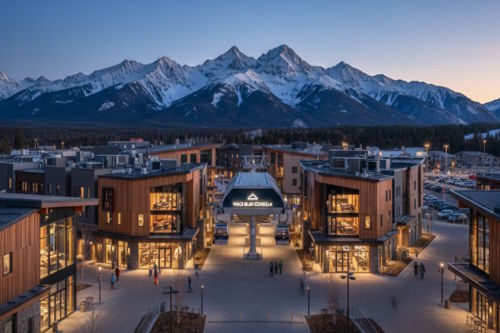
At Steamboat, the “Full Steam Ahead” project illustrates how capacity expansion is now inseparable from the underlying logistics of a resort. The Wild Blue Gondola – the longest and fastest in North America – is not simply an attraction, but a throughput solution. Yet projects of this scale reveal a deeper constraint: growth depends on transport flows, parking concepts, and coordinated planning between private operators and public stakeholders.
Snowmass, by contrast, represents a fully integrated masterplan. The billion-dollar redevelopment blends residences, hospitality, and retail into a cohesive destination. What distinguishes it is its extension beyond the resort core, incorporating employee housing across the surrounding valley. This dual structure – premium asset creation paired with social responsibility – has become a defining feature of the Colorado model.
At the same time, operators are increasingly moving toward four-season strategies. Summer activation through events, outdoor sports, and conference formats is no longer optional, but essential to stabilize revenue streams and justify large-scale capital expenditure.
Utah: Are We Watching New Alpine Cities Emerge?
Utah demonstrates what happens when development moves beyond expansion and into creation.
The Mayflower project at Deer Valley is one of the most ambitious resort developments in North America. With more than 800 hotel rooms and approximately 1,700 residential units, it introduces an entirely new base village connected to the existing lift system. Crucially, it integrates employee housing and regional systems from the outset.
Rather than extending an existing resort, Mayflower effectively builds a new urban node. For investors and operators, this marks a shift in development logic: large-scale hospitality projects in mature markets now require embedded solutions for workforce stability, mobility, and long-term livability.
In parallel, technology is becoming a silent differentiator. From mobile ordering in mountain restaurants to digitally managed guest flows, the operational layer is evolving alongside the physical one – particularly in response to peak-time congestion and staffing constraints.
California: Growth Under Constraint
In California, resort development is defined less by ambition and more by negotiation.
Mammoth Mountain continues to refine its base area redevelopment under extensive environmental review, reflecting how regulatory frameworks shape both timelines and feasibility. Capital alone is no longer sufficient to drive projects forward.
At Palisades Tahoe, years of litigation and community opposition led to a significant recalibration. The project was scaled down, employee housing was prioritized, and key infrastructure improvements were advanced. The outcome is a development model shaped through alignment rather than execution, where stakeholder acceptance becomes a core success factor.
Beyond Luxury: When Purpose Becomes Strategy
A growing number of resorts are moving beyond traditional luxury positioning and redefining their value proposition.
Taos Ski Valley has embedded social and environmental responsibility into its operating model, combining sustainability initiatives with tangible investment in staff accommodation. This approach reframes the resort not only as a destination, but as a long-term community asset.
Big Sky in Montana follows a similar trajectory through its multi-year masterplan, combining lift expansion with base-area improvements and housing initiatives developed in collaboration with local partners. The message is clear: long-term asset performance increasingly depends on ecosystem thinking rather than isolated development.
At the same time, projects of this scale often trigger operator transitions and repositioning processes behind the scenes. Not all of these shifts are communicated early, particularly when strategic alignment or ownership structures are still in motion – a dynamic that opens space for discreet transactions within the market.
What Does This Mean for Investors in Europe?
While the United States is currently leading in scale, the underlying questions are global.
For European investors, particularly in the Alpine region, the implications are tangible. The future of resort development will not be defined by room count or star ratings alone, but by the ability to secure workforce stability, extend seasonal demand, and align with local stakeholders.
The key takeaway is structural: hospitality assets are evolving into integrated systems. Their value is no longer driven solely by location and design, but by how effectively they function across operations, community, and long-term resilience.
Listing Your Property in a Shifting Market
As the hospitality landscape evolves, the right exposure becomes increasingly selective.
Owners and brokers who are considering a sale or repositioning can introduce their assets to a targeted network of professional buyers through our platform.