
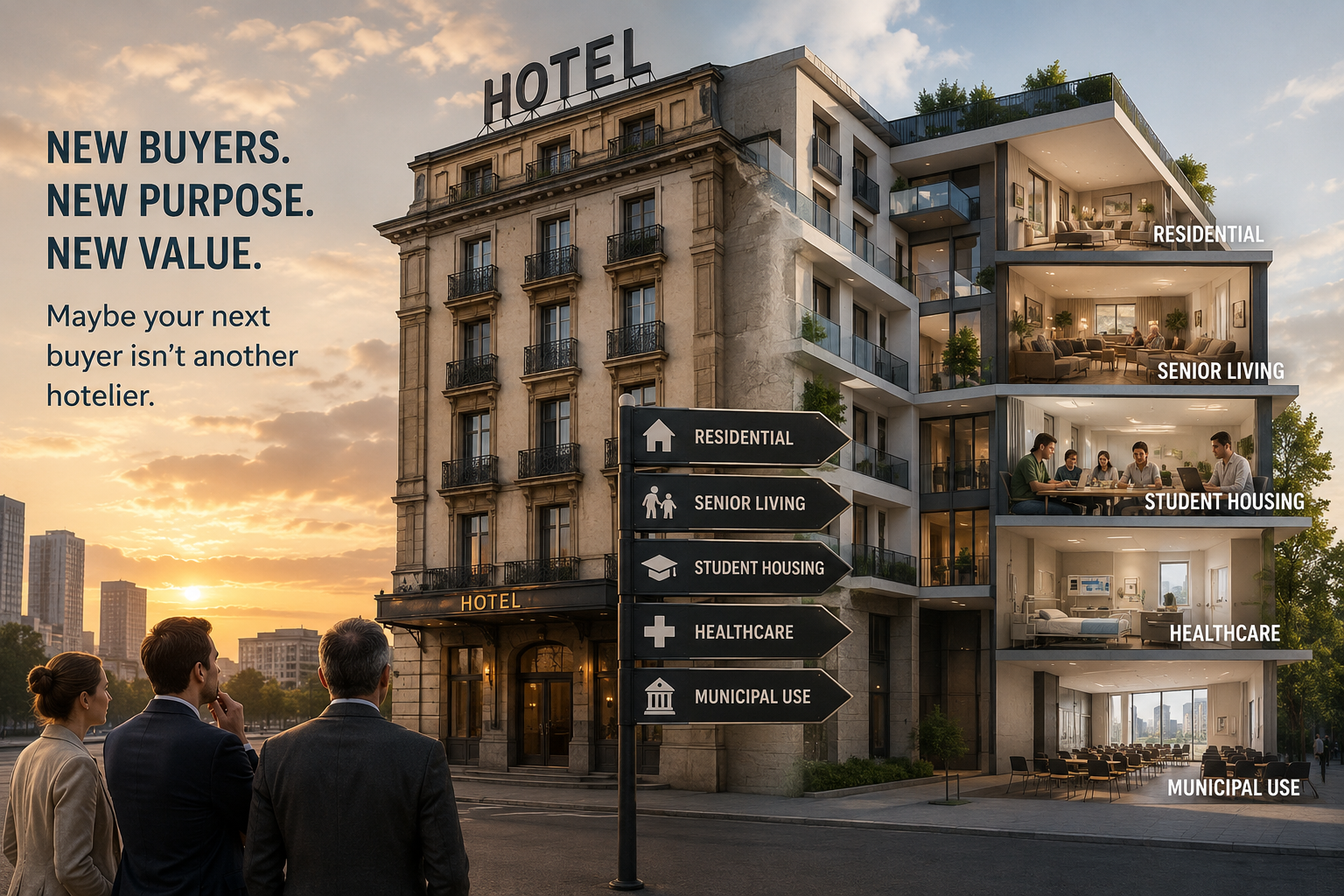
When a hospitality asset remains on the market for years, the standard response is often to lower the asking price. But what if the real problem is not the valuation, but a misalignment of markets, buyers and long-term potential?
For many hotel owners and their advisors, selling a hotel follows a remarkably familiar path. The property enters the market, marketing material is prepared, conversations begin with potential buyers and, eventually, the waiting starts. If months gradually turn into years without a serious offer, the industry’s response is usually predictable. The asking price is adjusted, new advertising is commissioned, or everyone simply waits for more favourable market conditions.
Yet this entire process rests on an assumption that is rarely questioned.
What if the property is not overpriced at all? What if it is simply being presented to too narrow a market for hotel buyers and other potential investors?
Hotels occupy a unique position within commercial real estate. Long before the first guest checks in, they already possess characteristics that are exceptionally difficult and expensive to recreate elsewhere. They are legally approved for accommodation, equipped with extensive plumbing infrastructure, individual bathrooms, fire safety systems, commercial kitchens, elevators and communal spaces designed to accommodate large numbers of people. In purely physical terms, they are among the most adaptable building types in commercial real estate.
Despite this inherent flexibility, many hotel transactions continue to revolve around the same relatively small circle of hospitality investors and operators.
Perhaps that assumption deserves to be reconsidered.
Looking Beyond the Traditional Market
When a hotel remains available for an extended period, the immediate conclusion is often that the asking price has become unrealistic. Yet there is another possibility that deserves equal consideration.
In many cases, the property has been professionally marketed and exposed to the market exactly as expected. The challenge is not necessarily the quality of the marketing itself.
The challenge may be the definition of the market.
Whether a hotel is offered through hospitality brokers, general real estate agencies, confidential sales processes or online property platforms ultimately matters less than one fundamental question: Who is actually expected to buy it?
Too often, the commercial conversation remains confined to buyers who already think like hoteliers. They analyse occupancy, RevPAR, historical EBITDA and operational performance because those are the metrics that traditionally determine the value of a hospitality business.
Yet an ageing conference hotel, a roadside property requiring substantial refurbishment or a midscale asset in a changing regional market may no longer derive its greatest value exclusively from overnight accommodation.
Sometimes the building itself has become more valuable than the business currently operating inside it.
At that point, expanding the circle of hotel buyers and alternative investors becomes considerably more important than expanding the advertising budget.
Expanding the Circle of Buyers
Once the discussion moves beyond traditional hospitality, an entirely different group of potential purchasers begins to emerge.
Municipalities facing severe housing shortages increasingly examine existing hotels as opportunities to create residential accommodation or public facilities without waiting years for new developments to pass through complex planning procedures. Across several North American and European cities, former hotels have already found a second life as affordable housing, temporary accommodation or community infrastructure.
Residential developers may approach exactly the same building from an entirely different perspective. Converting office buildings into apartments often requires expensive structural intervention because plumbing, bathrooms and circulation systems were never designed for residential use. Hotels, by contrast, already incorporate many of these essential elements, allowing developers to focus their investment on redesign rather than complete reconstruction.
The same principle applies to senior living operators and healthcare providers. Many hotel buildings already possess architectural characteristics that align remarkably well with assisted living facilities, rehabilitation centres or specialised residential care. Wide corridors, elevators, commercial kitchens and central building services often represent significant advantages rather than obstacles.
Student housing and co-living operators provide yet another perspective. Features that may appear commercially limiting within traditional hospitality—compact guest rooms combined with generous communal areas—can fit surprisingly well with contemporary shared living concepts where private accommodation is deliberately complemented by extensive communal space.
None of these buyers primarily evaluates historical occupancy figures or average daily rates.
They evaluate something else entirely.
They evaluate the economic value of an existing building that already contains much of the infrastructure their own projects would otherwise need to construct from the ground up.
For that reason, expanding the buyer pool is rarely achieved simply by placing an advertisement on another website. Different buyer groups participate in different professional networks, rely on different advisors and pursue acquisition opportunities through entirely different channels. Reaching them often requires a different commercial narrative, a different presentation of the asset and, above all, a broader strategic perspective.
Presenting the Asset Differently
Once the target audience changes, the way the property is presented must evolve as well.
A hotel operator naturally wants to understand historical operating performance, guest segmentation and commercial potential. A residential developer or institutional investor is more likely to focus on structural integrity, building services, zoning regulations, floor plate efficiency and the practical feasibility of adaptation.
The discussion gradually shifts away from operational performance and towards the long-term potential of the building itself.
Importantly, none of this suggests that every hotel should be converted or that hospitality has somehow reached its limits. Many properties will continue to generate their highest value as successful hotels for decades to come. A profitable luxury resort or a well-performing city hotel should not be viewed through the same lens as an ageing property struggling to attract serious buyers.
The objective is not to replace one market with another.
It is to recognise that some assets may deserve access to more than one market.
A Broader View of Value
Commercial buildings have always evolved alongside society. Factories become cultural districts. Warehouses become offices. Office towers become residential developments. Hotels should not automatically be regarded as the only building type whose purpose remains fixed throughout its entire existence.
When an asset remains unsold for years, the immediate conclusion is often that the asking price is too ambitious. Sometimes that is true. Yet there are equally compelling situations in which the asking price is entirely reasonable—the property has simply never been introduced to the buyers who would value it most.
For brokers, consultants and owners alike, this represents an opportunity to create value rather than merely negotiate discounts. By broadening the strategic conversation beyond the traditional hospitality sector, they may discover entirely new categories of investors who evaluate the same building through a fundamentally different commercial lens.
Conclusion: The Second Life of Hospitality Assets
The boundaries between hospitality, residential living, healthcare, education and mixed-use development are becoming increasingly fluid. Buildings no longer have a single predetermined purpose throughout their entire existence, and hotel properties are unlikely to remain an exception.
For owners facing prolonged sales processes, the most valuable question may therefore not concern price at all.
It may simply be this:
Who says the next buyer has to be another hotelier?
Because sometimes the greatest value of a hotel lies not in its first chapter, but in recognising when it is ready to begin its second.
Continue the Conversation
Hospitality assets are changing, and so are the conversations surrounding them. Every market has its own challenges, investment opportunities and success stories.
At Hogahero, we collaborate with hotel owners, consultants, developers, architects, operators and investors to publish well-researched sponsored articles that contribute meaningful ideas to the hospitality industry rather than simply promote products or services.
Whether you would like to present a development, share market expertise or introduce an innovative business concept, we’d be pleased to explore your story.
Visit our Partner with Us page or get in touch with our editorial team.